

Introduction
You've finalized your design, secured budget approval, and you're ready to order machined parts—but when you ask suppliers "how long will this take?" you get vague answers like "a few weeks" or "it depends." For engineers and procurement teams managing tight production schedules, this ambiguity makes planning nearly impossible.
CNC machining lead time varies dramatically. A simple aluminum prototype might ship in 1-3 days, while a complex production run requiring 5-axis machining and specialty finishing can stretch to 6-8 weeks. Knowing where your project lands on that spectrum is what separates accurate scheduling from guesswork.
This guide covers what you need to plan effectively:
- What CNC lead time actually includes (and what it doesn't)
- Realistic timelines by project type
- The most common causes of delay
- Strategies to speed up your next order, from prototype to production
TLDR: Quick Takeaways
- Standard CNC machining lead times range from 1–3 days for simple prototypes to 4–6+ weeks for complex production orders
- Part complexity, material availability, tolerances, and post-processing drive timeline more than cutting time
- DFM decisions made before machining begins have the greatest impact on lead time
- Complete drawings with proper GD&T eliminate the most preventable delays
- Rush orders are available but often cost 50–100% more (or higher for extreme timelines); plan ahead when possible
What Is CNC Machining Lead Time?
Lead time is the total elapsed time from when a confirmed order is placed (or quote is accepted) to when finished parts are ready for shipment. This is distinct from machine run time—the period a cutter is actively removing material.
Cycle Time vs. Lead Time: Why the Difference Matters
Cycle time is the actual time a CNC machine spends cutting a single part from start to finish once production begins. Lead time encompasses the entire workflow: quoting review, material procurement, scheduling queue, machine setup, machining, finishing, quality inspection, and packaging.
In contract machining, non-cutting activities routinely account for 30–60% of total elapsed time. For small lot sizes, shops can spend 90% of their time on setup and just 10% actually running the machine — which means cutting speed alone tells you very little about when your parts will ship.
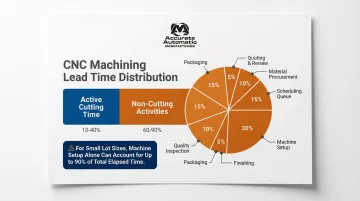
Customers often underestimate lead time because they picture only the machining step. In reality, a part that takes 20 minutes to cut might sit in a production queue for three days, wait two days for material delivery, and spend another week in outsourced anodizing. Knowing where those delays hide is what lets you plan around them.
Typical CNC Machining Lead Times: What to Expect
Lead times are best understood in categories based on project type and complexity rather than a single number.
Simple Prototypes (1-5 Business Days)
Parts in this tier typically share a few common traits:
- Low quantities (1-5 pieces)
- Straightforward geometry suited to 2.5- or 3-axis operations
- Standard materials such as aluminum 6061
- No specialty finishing required
When capacity is available, many shops turn these around fast—this is where "quick-turn" services operate. Protolabs and Fictiv offer 1-2 day turnarounds for eligible parts, while Hubs provides 5-day lead times for specific standard materials.
Standard Production Orders (1-3 Weeks)
Mid-range orders typically involve moderate complexity, tighter tolerances, multiple setups, or quantities in the dozens to low hundreds. Scheduling queue and material lead time become more significant factors here, especially for less common alloys or engineering plastics. This is the most common category for OEM and industrial buyers, with standard industry turnaround ranging from 7-14 days.
Complex or High-Volume Orders (4-8+ Weeks)
High-complexity work includes 5-axis machining, deep pockets, fine surface finishes, specialty materials (titanium, Inconel, hardened steels), or quantities in the hundreds to thousands. Multi-step post-processing alone—heat treating, anodizing, plating—can add 1-2 weeks.
For orders in this range, upfront timeline estimates depend heavily on a shop's in-house capabilities. A shop like Accurate Automatic MFG — handling CNC milling, turning, and screw machine work under one roof — can flag scheduling or material constraints early, before they become mid-project surprises.
Key Factors That Affect CNC Machining Lead Time
Part Design Complexity
Features requiring multiple setups—undercuts, deep cavities, tight internal radii—or 4- and 5-axis access each add programming time, specialized tooling selection, and longer machining cycles. Programming time for a simple 3-axis part typically takes 2-4 hours, while medium-sized 3+2 axis parts can require 2-3 working days, and highly complex aerospace parts can take a week or more.
A part with 20 features is not twice as complex as one with 10—complexity grows exponentially, not linearly. Using 5-axis machines can offset some of that growth; one analysis showed a 26.6% cycle time reduction by dropping from five setups to two.
Material Selection
Material choice affects both procurement lead time and machining speed:
Procurement impact: Standard aluminum stock is often on-hand; specialty alloys or certain plastics may require 1-2 weeks to source. Titanium lead times have reached 20-30+ weeks for specific aerospace grades.
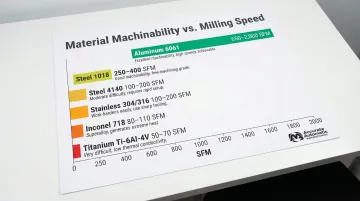
Machinability impact: Cutting speed varies dramatically by material. Aluminum 6061 mills at 650-2,000 SFM, while Inconel 718 cuts at just 80-110 SFM—a 10-20x difference that drastically inflates cycle times and tool wear.
| Material | Typical Milling Speed | Machinability Notes |
|---|---|---|
| Aluminum 6061 | 650-2,000 SFM | Soft, highly machinable, fast material removal |
| Steel 1018 | 250-400 SFM | Medium low-carbon steel, good machinability |
| Steel 4140 | 100-200 SFM | Harder than aluminum, requires slower feeds |
| Stainless 304/316 | 100-200 SFM | Hard, tough, higher tool wear |
| Titanium Ti-6Al-4V | 50-70 SFM | Very strong, requires careful heat management |
| Inconel 718 | 80-110 SFM | Extremely difficult to machine |
Shop Capacity and Scheduling Queue
Even with perfect design and material in hand, a shop's current backlog determines when your job gets on the machine. Busy seasons or rush periods can add days to weeks. Building a relationship with a trusted shop often means better scheduling priority—established customers at shops like Accurate Automatic MFG tend to benefit from faster turnaround and more predictable scheduling windows.
Post-Processing and Finishing Requirements
Outsourced finishing consistently adds significant time:
- Anodizing (Type II/III): 7-10 business days (Type III hardcoat requires 60-90 minutes in tank vs. 15-20 for Type II)
- Electroplating: 7-10 business days
- Powder coating: 5-7 days
- Heat treatment: 9+ working days for surface hardening
Stacking two or more finishing steps compounds these delays—plan for each one independently rather than assuming they overlap.
Quality Inspection and Documentation
Parts requiring CMM inspection reports, first article inspection (FAI), material certifications, or industry-specific documentation add meaningful time to the back end. CMM measurement typically requires 1-4 hours, followed by 4-8 hours for data analysis and formal report generation.
AS9102 FAI documentation for a complex part can consume 40 man-hours, with inspectors spending over an hour just filling out forms for a simple part with fewer than 10 callouts if done manually.
Common Causes of CNC Machining Delays
Most delays stem from a short list of avoidable issues, not unavoidable circumstances.
Design Issues Caught Late
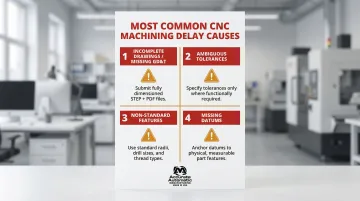
Common design problems that stall jobs include:
- Incomplete drawings or missing GD&T callouts
- Ambiguous tolerances that require clarification
- Sharp internal corners or non-standard thread sizes that can't be machined as drawn
- Missing datums or datums placed "out in space"
Each issue triggers back-and-forth communication that can delay a job by days. DFM review before order placement is the most effective fix.
Material Shortages and Substitutions
Supply chain disruptions or specifying a material that isn't standard stock can delay the start of machining. Typical delay ranges by material type:
- Standard metals (6061 aluminum, mild steel): minimal delay
- Engineering alloys: 1–3 days added
- Specialized stock: 5–7 days added
Agreeing on an acceptable substitute material early — before machining begins — is faster than waiting for an out-of-stock item.
Mid-Project Changes and Revisions
Engineering change orders (ECOs) mid-production are one of the most disruptive causes of delay. A study of Major Defense Acquisition Programs found that 63% required contractual changes after system development, with programs that had requirement changes seeing mean cost growth of 72% compared to just 11% for stable designs.
ECOs can reset your queue position, require new toolpaths, and scrap in-progress parts. Lock down designs before ordering.
Tips to Reduce Your CNC Machining Lead Time
Practical steps that buyers and engineers can take before and during their order to move fastest.
Design for Manufacturability (DFM) Before You Order
Simplifying geometry directly reduces programming time, setup complexity, and machining cycle time:
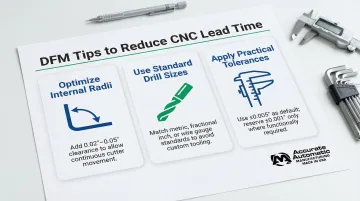
Optimize internal corner radii: If a part features a 0.25" radius and the machinist uses a 0.25" endmill, the tool must stop, pivot 90 degrees, and resume, causing vibration and adding time. Add 0.02"-0.05" to internal radii (model a 0.27" radius for a 0.25" tool) to allow continuous cutter movement.
Use standard drill sizes: Designing holes that don't match standard metric, fractional inch, or wire gauge sizes requires specialized tooling or slow pocket-milling with an endmill.
Apply practical tolerances: Standard machining tolerances are typically ±0.005". Specifying tighter tolerances (±0.001") requires specialized equipment, slower speeds, and rigorous CMM inspection, adding to costs and lead times.
Choose Materials Already in Stock
Confirm material availability with your shop before finalizing specs. Common aluminum alloys (6061, 7075), steel (1018, 4140), and standard engineering plastics are typically on-hand and eliminate procurement wait time. Research material substitutes with equivalent performance if a first-choice material has long lead time.
Submit Complete, Clear Documentation
Provide fully dimensioned drawings with proper ASME Y14.5 GD&T callouts, clear surface finish specifications, and all required tolerances from the start. This eliminates the most common source of quoting and production delays.
Preferred file formats:
- STEP (.stp) files for wide CAD/CAM compatibility and solid geometry retention
- 2D drawing PDF for dimensioning and tolerances
- Together, these give machinists everything they need to start without questions
Order Early and Batch Similar Parts
Build buffer time into project schedules—at least 50% more than the minimum quoted lead time. Batching multiple part numbers into one order is often more efficient than placing separate orders, as setup costs and scheduling are shared. A shop that runs CNC milling, turning, and screw machine work under one roof can often consolidate multiple part types into a single production run.
Communicate Urgency and Build Supplier Relationships
Be upfront with your shop about hard deadlines and project context (line-down situation, product launch). This allows them to prioritize appropriately. Ongoing relationships with a trusted shop—built on integrity and communication—often result in better scheduling flexibility and faster turnaround when time is critical.
Frequently Asked Questions
What is the typical lead time for CNC machining?
Lead times range from 1-3 days for simple prototypes with standard materials and basic geometry, up to 6-8 weeks for complex, high-volume orders requiring specialty alloys, tight tolerances, and extensive post-processing. Part complexity, material availability, finishing requirements, and shop capacity are the primary variables.
What is the difference between cycle time and lead time in CNC machining?
Cycle time is the machine-cutting time for a single part once production starts. Lead time covers everything from order confirmation to delivery—scheduling, procurement, setup, machining, finishing, and inspection—and runs 5-10x longer than cycle time alone.
Does material choice affect how long CNC machining takes?
Yes, significantly. Material affects both procurement time (exotic alloys may take 1-2 weeks to source, titanium up to 20-30 weeks) and machining speed (hard metals like titanium and Inconel machine 10-20x slower than aluminum, directly impacting cycle time and throughput).
How does part complexity affect CNC machining lead time?
Complex parts with tight tolerances (±0.001" or tighter), multiple setups, or 5-axis features can push programming alone from 2-4 hours to 2-3 days, plus add specialized tooling and longer run times. Complexity scales exponentially with feature count, not linearly.
What post-processing steps add the most time to CNC machining orders?
Outsourced processes like anodizing (7-10 days), electroplating (7-10 days), powder coating (5-7 days), and heat treatment (9+ days) are the biggest time adders. Each involves batch scheduling at third-party facilities plus transit time, often doubling total lead time.
Can I get CNC machined parts faster with a rush order?
Yes, though expedited service (1-3 days) carries a 30-50% surcharge, and same-day or emergency work runs 100-200% above standard rates. Rush orders are limited to simple geometries, in-stock materials, and basic tolerances (±0.005")—parts needing custom tooling or outsourced finishing aren't eligible for rush service.