Introduction
Manufacturers today face compounding pressures that make the status quo increasingly unsustainable. Tighter delivery windows, rising quality expectations, labor constraints, and margin compression are no longer isolated challenges—they're converging simultaneously. 79% of manufacturing leaders cite skilled labor shortages as a major obstacle, while raw material costs are projected to rise by an average of 5.4% over the next year.
Intelligent manufacturing delivers its real value at the operations level—where cycle times, defect rates, and throughput decisions are made daily. This article examines what it actually means in a precision machining context, and why the cost of inaction is rising faster than most shops realize.
Key Takeaways
- Intelligent manufacturing combines people, processes, machines, and data-driven technology to optimize production outcomes—quality, speed, and cost—at once
- Its three most impactful advantages are real-time process visibility, predictive quality control, and scalable operational efficiency
- It removes reactive firefighting by giving manufacturers foresight to act before problems escalate
- Applied consistently, it builds operational clarity and control that grows stronger over time
- Ignoring it means accepting higher error rates, rising costs, and limited ability to scale
What Is Intelligent Manufacturing?
Intelligent manufacturing is the integration of people, processes, and machines with intelligent technology and data analysis to improve how a facility performs and produces. Rather than a single tool, it's a framework of connected systems that work together across every layer of an operation.
This approach typically applies across:
Production floor operations:
- Machine monitoring and equipment performance tracking
- Quality inspection and defect detection
- Inventory control and material flow
- Production scheduling and workflow optimization
Back-office operations:
- Demand forecasting and capacity planning
- Supply chain visibility and coordination
- Compliance tracking and documentation
- Cost analysis and margin management
Intelligent manufacturing exists to deliver better results: fewer defects, less waste, lower costs, faster delivery, and greater confidence in every production decision. For contract manufacturers especially, that confidence matters — clients expect tight tolerances, on-time delivery, and no surprises.
Key Advantages of Intelligent Manufacturing
The advantages below are grounded in operational and financial outcomes—the metrics manufacturers actually track—not theoretical ideals.
Real-Time Process Visibility and Control
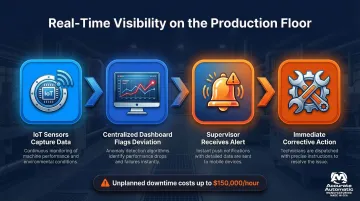
Real-time visibility means having a live, accurate picture of what's happening across the production floor at any given moment—not reconstructed from end-of-shift reports, but as it happens.
Connected machines and IoT sensors continuously feed data to centralized dashboards, flagging deviations in cycle times, equipment performance, or material usage the moment they occur. Supervisors see anomalies instantly rather than discovering them hours later during quality checks.
Catching a process deviation in real time prevents it from propagating into dozens of defective parts or a full line stoppage. The cost of correction multiplies rapidly the later a problem is identified—the 1-10-100 rule dictates that every $1 spent on prevention saves $10 on appraisal and $100 in failure costs.
This translates directly into faster, better decisions. Supervisors respond to anomalies with factual data rather than intuition—when a CNC machine shows abnormal vibration patterns, operators intervene immediately instead of running an entire batch of out-of-spec parts.
KPIs impacted:
- Overall equipment effectiveness (OEE)
- Unplanned downtime
- First-pass yield rate
- Mean time to detect (MTTD)
- Cycle time consistency
Real-time visibility has the highest impact in high-volume or multi-shift operations where floor conditions change rapidly and manual oversight cannot scale. Unplanned downtime costs SME manufacturers up to $150,000 per hour, making real-time detection a financial necessity rather than a nice-to-have.
Predictive Quality Control and Defect Reduction
Predictive quality control means using historical and live production data to anticipate quality failures before they occur—rather than inspecting for defects after the fact.
Data collected from machines, materials, and processes is analyzed to identify patterns that precede defects—enabling adjustments before non-conforming parts are produced. Tool wear patterns, temperature fluctuations, or material inconsistencies can all trigger alerts before they result in dimensional deviations.
The financial case is straightforward: top-performing manufacturers lose only 0.6% of revenue to scrap and rework compared to 2.2% for laggards. Rework, scrap, customer returns, and warranty claims compound quickly when a quality failure isn't caught early.
For manufacturers in regulated sectors, predictive quality also creates an auditable record of process control—supporting compliance with ISO 9001, AS9100, and IATF 16949, and building customer confidence through documented process integrity.
KPIs impacted:
- Defect rate (PPM)
- Scrap and rework costs
- Customer return rate
- First-pass yield
- Cost of quality (CoQ)
This has the highest impact in precision manufacturing environments, high-mix/low-volume production, and industries where tolerance deviations carry significant downstream risk—aerospace, automotive, and medical device manufacturing.
Operational Efficiency and Scalable Production
Operational efficiency in intelligent manufacturing means doing more with available resources—reducing waste of time, materials, and labor—without requiring proportional cost increases as volume grows.
By automating data collection and analysis, intelligent systems eliminate manual reporting overhead, reduce idle time through better scheduling, and enable continuous improvement based on real production data. Manufacturers implementing smart operations report 10-20% improvement in production output and 7-20% improvement in employee productivity.
Efficiency gains compound. A reduction in changeover time frees capacity for additional production runs without additional labor cost—with direct impact on margins and competitive pricing.
Scalability follows from the same foundation. Intelligent systems create repeatable, documented processes that handle higher volumes or new product lines without rebuilding operational knowledge from scratch. Documented processes ensure consistency regardless of which shift or operator handles the work.
KPIs impacted:
- Throughput rate
- Labor productivity
- Changeover time
- Material utilization rate
- Cost per unit
- Capacity utilization
This matters most when manufacturers are growing, taking on new customers, or managing increasing product complexity without expanding headcount proportionally.
What Happens When Intelligent Manufacturing Is Missing or Ignored
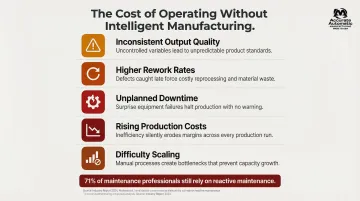
Without intelligent manufacturing systems, most manufacturers respond to problems after they happen. Decisions rely on incomplete or delayed information, and fixes address symptoms rather than root causes.
These gaps compound quickly. Common consequences include:
- Inconsistent output quality: Quality depends on individual operator judgment rather than process data, so defects cluster unpredictably and root causes stay hidden.
- Higher rework rates: Without predictive signals, defects reach final inspection — or the customer — before anyone catches them, creating costly correction cycles.
- Unplanned downtime: 71% of maintenance professionals still rely on preventive or reactive maintenance rather than predictive approaches, leaving equipment failures unexpected and expensive.
- Rising production costs: Waste, rework, and overtime become normalized. Margins erode as inefficiencies compound faster than pricing can absorb them.
- Difficulty scaling: Growth means rebuilding undocumented tribal knowledge from scratch — every new product line becomes a custom challenge instead of a repeatable process.
How to Get the Most Value from Intelligent Manufacturing
Intelligent manufacturing delivers the most value when applied consistently across the operation—not as a pilot in one area while the rest of the floor operates the old way. Inconsistency in adoption creates data blind spots and limits the system's ability to surface meaningful insights.
Two principles determine how much value you actually extract:
- Close the feedback loop. Data from intelligent systems has no operational value unless the people reviewing it are empowered to act on it. Weekly production reviews should directly inform process adjustments, maintenance schedules, and quality protocols.
- Treat culture as infrastructure. Intelligent manufacturing amplifies what's already present on the floor. Manufacturers that already prioritize quality and delivery discipline see faster returns because the behavioral foundation is in place.
This second point matters more than most manufacturers expect. When quality is a non-negotiable standard before intelligent systems are introduced, those systems enhance existing discipline rather than trying to build it from scratch.
Precision contract manufacturers like Accurate Automatic MFG, whose work is grounded in a quality-first operational culture, illustrate this well. Partnering with a manufacturer that already operates this way means the systems and processes are already aligned with the mindset that makes intelligent manufacturing work.
Conclusion
Intelligent manufacturing ultimately comes down to operational grip — knowing what is happening on the floor, making decisions based on real data, and producing consistent output every cycle. That combination directly reduces cost, protects quality, and builds the kind of reliability customers return for.
The gains compound. Early investments in process visibility generate data that becomes more useful the longer it accumulates — shifting operations from reactive firefighting to genuine predictability.
Intelligent manufacturing works best as an ongoing practice, not a one-time deployment. Manufacturers who integrate systems gradually, act on the insights those systems surface, and build a culture around data-driven decisions will find it easier to take on more complex work, tighten tolerances, and hold delivery commitments even as demand scales.
Frequently Asked Questions
What is the difference between intelligent manufacturing and smart manufacturing?
The terms are often used interchangeably, but intelligent manufacturing emphasizes the integration of human judgment with technology—people, processes, and machines working together. Smart manufacturing more commonly refers to the technology infrastructure (IoT, automation, connectivity) that enables it.
What technologies are typically used in intelligent manufacturing?
Core enabling technologies include:
- IoT sensors and connected machines for real-time data capture
- Manufacturing execution systems (MES) for workflow management
- Data analytics platforms for pattern recognition
- Automation and robotics for consistent execution
- Real-time monitoring dashboards for process visibility
These tools are most effective when integrated, not deployed in isolation.
Is intelligent manufacturing only viable for large manufacturers?
No. Intelligent manufacturing principles apply at any scale, and many solutions are modular. Smaller manufacturers often see faster ROI because gains in a tighter operation are immediate and visible—starting with one bottleneck machine can prove value before any broader commitment.
How does intelligent manufacturing specifically improve product quality?
Continuous data collection from machines and processes enables early detection of deviations that lead to defects. This shifts quality management from reactive inspection to proactive prevention, catching issues like tool wear or temperature drift before they produce non-conforming parts.
What is the first practical step a manufacturer should take to adopt intelligent manufacturing?
Start with a production data audit: identify what data you're already collecting, where the gaps are, and which process areas carry the highest variability or cost. That baseline tells you which technology investments will deliver the fastest ROI before you commit to any platform.
How does intelligent manufacturing reduce production costs?
Cost reduction happens across three areas: fewer defects through predictive quality control, less unplanned downtime through predictive maintenance, and better resource utilization through improved scheduling and process visibility. As your data matures, the accuracy—and the savings—of each area increases.