Introduction
Sheet metal fabrication has been a cornerstone of industrial manufacturing for generations—but the way it's done has fundamentally changed. Picture a skilled craftsman manually operating a press brake, measuring angles by eye and adjusting tooling by hand. Now contrast that with today's CNC-driven laser cutters and automated forming centers executing the same task with programmed precision, no manual interpretation required.
For manufacturers, the choice between CNC and traditional methods directly affects part accuracy, production speed, material waste, labor costs, and the ability to scale. These aren't abstract tradeoffs—they show up in every quote, lead time, and scrap report.
According to the Fabricators and Manufacturers Association (FMA), 70.87% of metal fabricators plan to evaluate new press brakes in 2026, driven by skilled operator shortages and growing pressure to automate. This guide breaks down where each approach wins—and where it falls short.
Key Takeaways
- CNC sheet metal fabrication uses computer-controlled machines to cut, bend, and form metal with programmed precision
- Traditional methods rely on manual or semi-manual equipment operated by skilled workers
- CNC delivers tighter tolerances (±0.005″ range), greater repeatability, and faster throughput for higher-volume runs
- Traditional methods have lower upfront setup costs and remain effective for simple, low-volume, or one-off parts
- The right choice depends on part complexity, required tolerances, production volume, and budget
CNC vs. Traditional Sheet Metal Fabrication: Quick Comparison
The differences between CNC and traditional sheet metal fabrication show up across every stage of production — from first cut to final inspection. Here's how the two approaches stack up on the factors that matter most.
| Factor | CNC Methods | Traditional Methods |
|---|---|---|
| Precision & Tolerances | Consistent ±0.005″ range; fiber lasers achieve 0.0019″ | Operator-dependent; generally wider tolerances |
| Production Speed | Faster cycle times after setup; ideal for repeat runs | Slower per-part throughput, especially for complex geometries |
| Setup Cost | Higher initial programming and tooling setup cost | Lower upfront cost for simple or one-off jobs |
| Material Waste | Optimized nesting software reduces scrap by 3–5% | Manual layout typically generates more offcut waste |
| Scalability | Easily repeatable across large runs with no quality degradation | Quality varies run-to-run due to operator fatigue or skill variation |
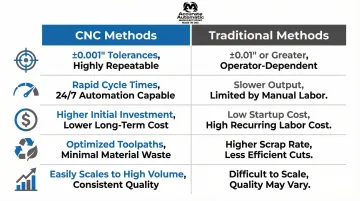
The right choice depends on your volume, tolerance requirements, and budget — factors explored in detail throughout the sections below.
What is CNC Sheet Metal Fabrication?
CNC sheet metal fabrication uses computer numerical control (CNC) technology to automate the cutting, bending, punching, and forming of sheet metal according to CAD/CAM-programmed specifications. The "CNC" designation refers to the control method—not a single machine—and encompasses laser cutters, CNC press brakes, turret punch presses, and automated forming centers.
A digital design (CAD file) is translated into machine-readable G-code or M-code, which tells the machine where to cut, how fast to move, what bend angles to hold, and where to punch. This eliminates manual interpretation at every step and enables consistent execution across every part in a run.
Core CNC Sheet Metal Techniques
- Laser cutting: CO2 or fiber laser for high-precision profiling; fiber lasers cut thin sheet metal 3 to 5 times faster than CO2 lasers with significantly lower energy consumption
- CNC press brake forming: Automated back gauging and adaptive angle measurement for repeatable bends
- CNC turret punching: High-speed hole patterns, cutouts, and forming operations in a single setup
- Plasma cutting: Suited for thicker stock and heavy mechanized cutting applications
These techniques share a common operational advantage: programs are stored and recalled exactly, so first-article quality is reproduced on the 500th part without re-setup. Additional benefits include:
- Reduced human error through automated execution
- Higher throughput with consistent quality across production runs
- Material versatility across aluminum, stainless steel, cold-rolled steel, copper, and specialty alloys with digital parameter adjustments
Use Cases of CNC Sheet Metal Fabrication
CNC is the right fit when consistency, traceability, or volume are non-negotiable. Common applications include:
- High-volume production runs requiring part-to-part consistency
- Components with tight dimensional tolerances: enclosures, brackets, chassis, panels
- Parts with complex or repeating hole patterns
- Projects requiring digital repeatability for quality documentation
The industries driving the most CNC sheet metal demand reflect those requirements directly:
- Aerospace: Tight tolerances and AS9102 First Article Inspection requirements mandate complete traceability from raw material to final inspection
- Automotive: OEMs are replacing stamping presses with coil-fed laser blanking lines achieving 75% OEE for high-volume structural components
- Electronics: Enclosures, heat dissipation panels, and server racks for data centers
- Industrial equipment: Machine guards, frames, and housings
- Medical devices: Precision enclosures requiring ISO 13485 compliance and immutable digital traceability
What Are Traditional Sheet Metal Fabrication Methods?
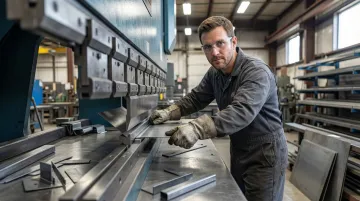
Traditional sheet metal fabrication covers processes where metal is cut, bent, and assembled using manually operated or semi-automated equipment. That includes manual shears, hand-set press brakes, oxy-fuel cutting, and manual welding. These methods aren't obsolete. They remain in active use and deliver genuine value in the right context.
Core workflow difference: In traditional fabrication, the operator interprets the drawing, sets up the tooling by hand, and controls the process directly. Skill, experience, and judgment directly determine output quality and tolerance consistency—the operator's capability shapes every part produced.
Primary techniques:
- Manual shearing — Straight-line cuts through mechanical blade action; fast for simple profiles
- Hand-set press brake bending — Operator sets and adjusts bend angles directly at the machine
- Oxy-fuel or manual plasma cutting — Better suited to thicker stock where tight tolerances aren't required
- Hand layout — Part profiles scribed manually from drawings before cutting
Genuine strengths:
- Lower programming overhead for one-off or highly custom parts
- Lower capital equipment requirements
- Skilled-trade flexibility for non-standard geometries
- Real-time adjustments on the shop floor without reprogramming
Use Cases of Traditional Sheet Metal Methods
Where traditional methods remain competitive:
- Low-volume custom fabrication (single prototypes, repair parts, short-run specials)
- Simpler geometries where tight tolerances are not required
- Job shops handling highly varied work with small batch sizes
- Applications where CNC setup cost outweighs the precision benefit
Industries and applications:
- Architectural metalwork and custom HVAC ductwork
- Agricultural equipment repairs
- Maintenance and repair operations (MRO)
- Artisanal or specialty fabrication work
CNC vs. Traditional Sheet Metal Fabrication: Which Method is Right for Your Project?
Primary decision factors:
- Required part tolerances and quality consistency
- Production volume and run frequency
- Part complexity and geometry
- Total cost across setup plus per-part production
- Lead time requirements
Situational Guidance
Choose CNC sheet metal fabrication when:
- Tolerances are tight (±0.005″ or better)
- You need to reproduce the same part reliably across dozens or thousands of units
- The part involves complex cut profiles, dense hole patterns, or precise bend sequences
- Digital traceability is required for compliance (aerospace, medical)
Choose traditional methods when:
- Producing a single custom part or repair piece where programming time would exceed fabrication time
- Working with straightforward geometries on a constrained budget
- Field installation or on-site adjustments are required
The Cost Nuance
CNC carries higher upfront setup costs (programming, tooling verification), but the per-part cost drops sharply at volume. Traditional methods may appear cheaper on one-offs but scale poorly due to labor time and potential rework.
Nesting software routinely delivers 3–5% material savings — CPI cut material waste by 5%, saving $50,000 annually through optimized nesting alone. Programmed repeatability also sharply reduces the rework and scrap risk that comes with operator variability in traditional methods.
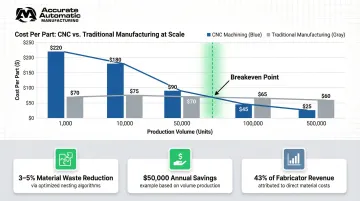
That reduction matters more than it sounds. According to FMA's 2023 survey, direct material costs now average 43% of a fabricator's sales — meaning every percentage point saved through CNC nesting optimization has a direct, measurable impact on the bottom line.
Real-World Applications: When Each Method Wins
CNC Success: Olympic Steel
By upgrading to Hypertherm's ProNest software, Olympic Steel decreased production time by 12% to 40% through Common Line Cutting. The software's Collision Avoidance feature eliminated 95% of laser head raises, saving over an hour of production time per day per laser and reducing machine wear.
Challenge: Inefficient nesting created material waste and slow throughput
Solution: Advanced CAD/CAM nesting with automated optimization
Outcome: 12-40% faster production, 95% reduction in laser head raises, significant material savings
Traditional Method Retention: On-Site HVAC
SMACNA contractors retain manual shears and hand-brakes for field-fitting ductwork. The functional standards for duct deflection and reinforcement often require on-the-fly adjustments that cannot be pre-programmed into a CNC machine off-site. For these applications, traditional methods remain the practical choice.
Practical takeaway: The "right" method is determined by the specifics of the job, not by a general rule. Understanding where each method excels helps you make smarter sourcing decisions before the project starts. To discuss precision machining for your next component, reach out to Accurate Automatic MFG at sales@accurateautomaticmfg.com or call +1 330-435-4575.
Conclusion
CNC sheet metal fabrication delivers superior precision, repeatability, and efficiency for complex or high-volume production—while traditional methods retain a legitimate role in custom, low-volume, or repair-focused work. The decision should always start with the part's requirements, not the method's prestige.
The key comparison points connect directly to real operational outcomes manufacturers care about: cost per part, first-pass yield, lead time, and production scale. With 70.87% of fabricators evaluating new CNC equipment and material costs reaching 43% of sales, the pressure to optimize both precision and efficiency has never been higher.
The right manufacturing partner brings enough capability range to match the process to the part—not default to a single method regardless of fit. Whether a project calls for the tight tolerances of CNC or the cost-effectiveness of traditional methods for lower volumes, the trade-offs covered here give you a clear framework for that call. Companies like Accurate Automatic MFG operate across multiple machining disciplines precisely because most production environments don't fit neatly into one category.
Frequently Asked Questions
What is the main difference between CNC sheet metal fabrication and traditional sheet metal methods?
CNC uses computer-programmed machines for automated, precise execution, while traditional methods rely on manually operated equipment and operator skill. The core difference centers on precision, repeatability, and throughput—CNC eliminates manual interpretation at each step.
Is CNC sheet metal fabrication more expensive than traditional methods?
CNC carries higher upfront setup and programming costs but lower per-part costs at volume. Traditional methods are cheaper for one-off or simple jobs, while CNC nesting (3–5% waste reduction) offsets setup costs in medium to high-volume runs.
Which method is better for high-volume production runs?
CNC sheet metal fabrication wins for high-volume runs—programmed repeatability, faster cycle times, and consistent quality eliminate the variation and fatigue that affect manual operations. Fiber lasers alone cut thin materials 3–5 times faster than manual equivalents.
What tolerances can CNC sheet metal fabrication typically achieve?
CNC sheet metal fabrication commonly achieves tolerances in the ±0.005″ range, with fiber lasers reaching 0.0019″ positional accuracy. Press brakes measure accuracy in angular tolerance (±0.2°) and backgauge repeatability (±0.02mm). Traditional methods depend entirely on operator skill, producing wider and less predictable tolerances.
Can traditional and CNC methods be used together in the same fabrication workflow?
Yes, many precision shops integrate both—using CNC for high-tolerance or repeating features and traditional methods for secondary operations, fixturing, or one-off modifications. This hybrid approach optimizes cost and quality by matching each process to its ideal application.
What industries benefit most from CNC sheet metal fabrication?
Aerospace, automotive, electronics, industrial equipment, and medical device manufacturing benefit most due to demands for tight tolerances, part traceability, and consistent quality at volume. Regulatory requirements like AS9102 and ISO 13485 mandate the digital traceability that only CNC systems can provide.