Introduction
Product development teams face a recurring problem: prototypes that fail to match final material specifications, break down under real-world testing, or require costly rework before production can begin. These failures can consume weeks—or entire development cycles—delaying time-to-market and inflating budgets.
CNC machining solves this by transforming digital CAD files into functional, dimensionally accurate prototype parts using the same engineering-grade materials as the final product. This subtractive manufacturing process removes material from solid stock with precision tooling, producing prototypes that behave like production components rather than visual mockups.
Understanding how this process works can help teams make faster, more cost-effective prototyping decisions. This guide covers:
- The mechanics of CNC precision prototyping
- Key advantages over alternative methods
- Industries that depend on it most
- How it compares to 3D printing and injection molding
- What to look for when choosing a manufacturing partner
Key Takeaways
- CNC machining achieves tolerances as tight as ±0.002 inches, producing prototypes functionally identical to final production parts
- Eliminates tooling costs and compresses timelines; updated CAD files become physical parts in days
- Works with production-grade materials (aluminum, steel, titanium, PEEK, Delrin) for accurate mechanical and thermal testing
- Trusted across aerospace, medical, automotive, and electronics applications where dimensional accuracy is critical
What Is CNC Precision Prototyping and Why Does It Matter?
CNC (Computer Numerical Control) machining is an automated manufacturing process where multi-axis cutting tools follow programmed toolpaths derived directly from CAD files. These tools carve, mill, drill, and turn prototype parts from solid material blocks—no molds or tooling required. In the prototyping context, this means engineers can order a single part or small batch without the upfront investment required by molded processes.
Precision prototyping means producing prototype parts that replicate the final product's geometry, material properties, and surface finish closely enough to support functional testing, regulatory submission, and design validation. These are functional prototypes that perform like production parts, not concept models or visual mockups.
That distinction comes down to material fidelity and dimensional accuracy. CNC machining delivers on both:
- Works with production-grade materials at the prototyping stage
- Holds tolerances equivalent to finished production parts
- Requires no minimum order quantities for prototype runs
A prototype machined from 6061 aluminum exhibits the same mechanical properties as a production part from the same alloy. That means engineers can run meaningful load tests, thermal cycling, and fatigue analysis on prototype parts—something impossible with 3D-printed substitutes or visual models.
The global metal molds market for plastic injection molding is valued at $4.5 billion, underscoring the massive capital locked in production tooling. CNC prototyping mitigates the risk of this investment by ensuring designs are fully validated before a single mold is cut.
Key Advantages of CNC Machining in Product Development
Dimensional Accuracy and Tight Tolerances
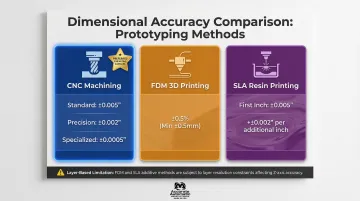
Modern CNC machines routinely achieve standard tolerances of ±0.005 inches (0.13 mm) across most features. For precision-critical features like bearing bores or mating surfaces, tolerances tighten to ±0.002 inches (0.051 mm), and specialized operations like reamed holes can reach ±0.0005 inches (0.0127 mm).
This precision far exceeds what additive manufacturing delivers without extensive post-processing. FDM 3D printing holds tolerances no tighter than ±0.5% (lower limit ±0.5 mm), while SLA achieves ±0.005 inches for the first inch, then adds ±0.002 inches per additional inch.
Both methods also suffer from layer-based construction that introduces stair-stepping, warping, and dimensional inconsistency on mating surfaces. Tight-fitting assemblies, threaded interfaces, press-fit components, and fluid seals require accuracy that only CNC machining can reliably deliver at the prototype stage — if components don't fit together precisely, you cannot validate the assembly.
Speed and Rapid Iteration
Automated quoting platforms and advanced CAM (Computer-Aided Manufacturing) software have compressed CNC lead times dramatically. A 2023 study found that companies using CNC for rapid prototyping reduced their product cycle time by 32% compared to traditional fabrication methods.
Typical CNC lead time tiers:
- Express (1-3 business days): Premium-priced, domestic manufacturing for urgent projects
- Standard (4-10 business days): Balanced speed and cost, the most common option
- Economy (12-20+ days): Lowest cost, often overseas manufacturing
The CAD-to-part workflow eliminates the tooling and mold-making steps required by injection molding. Designers receive a functional part, run tests, update the digital model, and reorder—sometimes within the same week. Injection molding can't match that cycle; tooling changes alone take weeks.
Production-Representative Materials
CNC prototypes are machined from the exact same materials as production runs. Common options include:
- Metals: 6061 aluminum, 316 stainless steel, titanium Grade 5
- Plastics/composites: PEEK, Delrin, nylon
This material fidelity means mechanical testing, thermal testing, and fatigue analysis yield data that genuinely reflects the final product's behavior.
Testing a prototype made from a 3D-printed resin simulant provides invalid data for a production part that will be injection-molded from polycarbonate or die-cast from aluminum. The mechanical properties simply don't match. CNC machining eliminates this disconnect.
Eliminates Early-Stage Tooling Investment
Unlike injection molding or die casting, CNC prototyping requires zero upfront tooling investment. Injection molding demands significant capital before producing a single part:
- Prototype aluminum molds: $2,500–$25,000, 2-6 weeks lead time
- Production steel molds: $15,000–$100,000+, 8-20+ weeks lead time
NASA and systems engineering research documents the "10x rule" of error cost escalation: a flaw caught in the design phase costs 1 unit to fix. That same flaw costs 7–16 units in manufacturing, 21–78 units during testing, and up to 1,500 units once the product is in operation.
CNC prototyping catches these flaws in the design phase using functional, production-grade parts—before expensive tooling is cut.

Materials Used in CNC Prototype Machining
Common Metals for CNC Prototyping
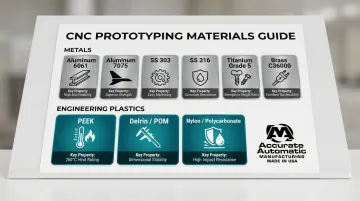
- Aluminum 6061-T6 — Excellent corrosion resistance and strength-to-weight ratio. Used for aerospace fittings, automotive brackets, and electronic enclosures. Accepts anodizing well.
- Aluminum 7075-T6 — Highest-strength aluminum alloy at 83,000 psi tensile strength. Common in highly stressed aerospace and defense structures.
- Stainless Steel 303 — Free-machining stainless with good corrosion resistance. Used for shafts, valve bodies, and fittings; sulfur content enhances machinability.
- Stainless Steel 316/316L — Superior pitting resistance for medical devices, marine, and chemical processing applications. Excellent weldability, though it work-hardens rapidly.
- Titanium Grade 5 (Ti-6Al-4V) — Exceptional strength-to-weight ratio and biocompatibility for aerospace airframes and medical implants. Requires slow speeds and heavy feeds during machining.
- Brass C36000 — Excellent electrical conductivity and low friction. Used for gears, connectors, and fittings; the benchmark material for machinability at a 100% rating.
When metal isn't required, engineering plastics offer lighter, cost-effective alternatives with their own performance advantages.
Engineering Plastics for CNC Prototyping
- PEEK — Thermally stable to 260°C with strong chemical resistance. Used in medical implants and aerospace components. Requires carbide or diamond-tipped tools; annealing is critical to relieve residual stresses.
- Delrin (Acetal/POM) — High strength, low moisture absorption, and excellent dimensional stability. The go-to choice for precision gears and bearings.
- Nylon and Polycarbonate — Good impact resistance for structural housings and mechanical prototypes. Both machine cleanly with standard tooling.
Material selection guidance: Choose the same material for your prototype as you intend for production. This ensures test data accurately reflects final product behavior. Material choice also affects surface finish options—aluminum accepts anodizing, stainless steel can be passivated, and many plastics can be textured or polished.
Industries That Rely on CNC Precision Prototyping
Aerospace and Defense
Aerospace prototyping demands strict tolerances (±0.002 mm to 0.01 mm), lightweight alloys (aluminum, titanium), and regulatory traceability. Every prototype component requires documented material certification (Material Test Reports or MTRs) proving chemical composition, mechanical properties, and heat lot traceability.
Key compliance requirements CNC machining supports include:
- AS9100 quality management standards for design and production control
- AS9102 First Article Inspection (FAI) documentation and dimensional verification
- Production-matched material properties for flight-critical component validation
Approximations aren't acceptable at this stage — regulatory approval depends on prototypes that perform exactly as production parts will.
Medical Devices and Surgical Instruments
The FDA regulates medical device development under 21 CFR Part 820.30 (Design Controls), requiring manufacturers to validate that devices meet user needs and intended uses.
For surgical instruments and implants, prototypes must be machined from certified biocompatible materials — such as ASTM F136 (Ti-6Al-4V ELI) or medical-grade PEEK — to support ISO 10993 biological evaluation.
Using exact production materials and CNC processes during the prototype phase ensures verification data can legally and scientifically support subsequent regulatory submissions. Testing with non-certified materials yields invalid data, risking regulatory rejection.
Automotive and EV Development
Automotive OEMs and Tier 1 suppliers use CNC prototyping for structural brackets, powertrain housings, and battery enclosures — parts that must survive vibration, thermal cycling, and load testing before design sign-off.
As the industry shifts toward electric vehicles, CNC machining allows engineers to quickly refine complex, lightweight aluminum and magnesium housings without committing to expensive die-casting tooling.
Consumer Electronics and Industrial Equipment
Tight dimensional tolerances define electronics manufacturing. Enclosures, heat sinks, and mounting hardware must achieve exact alignment with PCBs and internal components, with IPC-2221A dictating strict clearances for electronic packaging and heatsink integration.
CNC machining achieves the tolerances needed for press-fit interfaces, threaded mounting points, and RF shielding — tolerances that 3D-printed equivalents often cannot hold without secondary machining operations.
CNC Machining vs. Alternative Prototyping Methods
| Feature | CNC Machining | 3D Printing (FDM/SLA) | Injection Molding (Soft Tooling) |
|---|---|---|---|
| Lead Time | 1-10 days | 1-3 days | 2-6 weeks |
| Tooling Cost | $0 | $0 | $2,500–$25,000 |
| Per-Unit Cost (1-50 qty) | High | Low to Medium | Very High |
| Material Fidelity | Exact production metals/plastics | Simulants, resins, specific thermoplastics | Exact production plastics |
| Dimensional Accuracy | ±0.005" standard, ±0.002" precision | ±0.5% to ±0.005" | Excellent (tooling dependent) |
When to use each method:
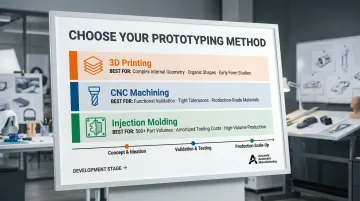
- Use 3D printing for complex internal geometries, organic shapes, or early-stage form studies where dimensional tolerance is less critical. Material fidelity is limited to simulants and resins.
- Use CNC machining for functional validation parts requiring tight tolerances and production-grade materials — the right choice when test results need to reflect actual production performance.
- Use injection molding only after crossing a critical quantity threshold (typically 500+ parts) where tooling costs can be amortized across volume.
The hybrid workflow: Many development programs combine both methods. 3D printing handles rapid overnight iterations to test form, fit, and ergonomics. Once macro-geometry is locked, CNC machining takes over for functional prototypes that undergo mechanical load testing.
A second approach: 3D print near-net shapes to rough geometry, then CNC mill the critical mating surfaces, bearing bores, and tapped threads to tight tolerances. This captures the speed of additive manufacturing without sacrificing dimensional precision where it matters.
Known CNC limitations to plan around:
- Sharp internal corners retain a radius equal to the cutting tool diameter — not machinable as true 90° inside corners
- Deep internal channels (depth exceeding 4× tool diameter) are prone to tool deflection and chatter
- Severe undercuts or fully enclosed cavities require 5-axis machining, split assemblies, or Electrical Discharge Machining (EDM)
What to Look for in a CNC Prototyping Partner
Key capability indicators:
- Multi-axis machining: 3-axis machines handle most parts; 5-axis machines access complex geometries and undercuts without repositioning
- Material stock breadth: In-house inventory of common alloys and engineering plastics reduces lead times
- Quality inspection equipment: CMM (coordinate measuring machines), surface profilometers, and optical comparators verify dimensional accuracy
- Prototype-to-production continuity: Ability to handle one-off prototypes and low-volume bridge production under the same quality system
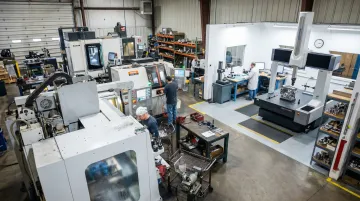
Design-for-manufacturability (DFM) feedback separates capable partners from order-takers. A strong prototyping shop reviews CAD files and proactively flags features that will drive up cost or reduce tolerance compliance, rather than simply cutting whatever they're given. That consultation catches expensive design flaws before any metal is cut.
Accurate Automatic MFG offers that combination in practice — CNC milling, CNC turning, screw machine operations, and engineering support under one roof, covering the full path from early prototype through production-ready components.
Frequently Asked Questions
What tolerances can CNC machining achieve for prototype parts?
CNC machining routinely achieves standard tolerances of ±0.005 inches (±0.13 mm) for most features. Precision-critical features like bearing bores or mating surfaces can hold ±0.002 inches (±0.051 mm), and specialized operations like reamed holes achieve ±0.0005 inches (±0.0127 mm), making CNC suitable for functional validation and regulatory testing.
How long does CNC prototyping typically take from CAD file to finished part?
Simple to moderately complex CNC prototypes are typically delivered in 3-10 business days, with express services turning around urgent parts in 1-3 days. That's well ahead of tooled processes like injection molding, which require 2-6 weeks for prototype tooling alone.
What materials can be used for CNC machined prototypes?
CNC machining works with most machinable metals and engineering plastics, including aluminum alloys (6061, 7075), stainless steel (303, 316), titanium Grade 5, brass, PEEK, Delrin, and polycarbonate. Using the same material as the final production part ensures test data accurately reflects production performance.
How does CNC prototyping differ from 3D printing for product development?
CNC removes material from solid stock, delivering tighter tolerances (±0.005" vs. ±0.5% typical for 3D printing) and production-grade materials with consistent mechanical properties. 3D printing builds parts in layers and works better for complex internal geometries or early concept models where tolerances and material match aren't critical.
What industries benefit most from CNC precision prototyping?
Aerospace, medical devices, automotive/EV, and consumer electronics are primary users due to their shared need for tight tolerances, production-representative materials, and regulatory-quality documentation. These industries cannot rely on approximations—prototypes must match production specifications for testing data to be valid.
When is CNC machining not the best prototyping method?
CNC is less suited for parts with complex internal cavities, severe undercuts, or organic geometries that would require excessive tool access or setup time. When only a rough visual mockup is needed for initial concept validation, 3D printing is faster and more cost-effective at the earliest concept stage.