Introduction
In automotive manufacturing, precision is non-negotiable. A crankshaft journal out-of-round by just 0.00012 inches can compromise engine balance and longevity. A brake rotor with thickness variation exceeding 0.0005 inches causes pedal pulsation that drivers feel with every stop. Modern vehicles contain roughly 30,000 individual parts, and each critical component demands tolerances that leave zero room for error.
CNC machining is the technology that makes this level of precision possible at scale. By eliminating human error through computer-controlled automation, CNC machines reproduce identical parts to exact specifications across thousands of production cycles — and assembly lines simply cannot function without that consistency.
From prototype engine blocks to high-volume transmission gears to electric vehicle battery enclosures, CNC machining touches virtually every system in a modern vehicle.
What follows covers the major applications, dominant processes, key materials, and how CNC machining is driving the shift to electric vehicles.
TLDR:
- CNC machining delivers sub-micron repeatability essential for 30,000-part vehicle assemblies
- Engine components like crankshafts require tolerances as tight as 0.0001 inches
- Aluminum content per vehicle will reach 556 pounds by 2030, driven by EV lightweighting demands
- Electric vehicles will capture 40% of global sales by 2030, creating new precision machining requirements
- 5-axis CNC reduces setups by 60% and cycle times by 30% for complex automotive geometries
Why CNC Machining Is Essential for the Automotive Industry
Managing 30,000-Part Complexity at Scale
The modern passenger vehicle comprises approximately 30,000 individual parts down to the smallest fasteners. Even when grouped into assemblies, a vehicle contains roughly 1,800 separate major components. Manual machining cannot deliver the consistency or speed required to manufacture these parts at automotive production volumes. CNC machining bridges the gap between raw castings or forgings and final assembly, providing programmable precision that ensures every part meets dimensional specifications across thousands of production cycles.
Computer-Controlled Consistency Eliminates Human Error
Once a CNC program is written and validated, the machine reproduces the same part to exact specifications indefinitely. This automation is critical for assembly line production, where downstream stations depend on parts arriving within tolerance. A single out-of-spec component can halt an entire production line, cascading delays across the supply chain. CNC machining's digital control eliminates the variability inherent in manual operations — ensuring dimensional consistency that assembly lines depend on.
High-Mix/Low-Volume Production Flexibility
The automotive industry is shifting from dedicated high-volume transfer lines toward high-mix/low-volume (HMLV) production models. Consumer demand for vehicle customization, faster model redesign cycles, and the proliferation of electric and hybrid variants all require flexible manufacturing systems.
CNC machining's programmability is well suited to this environment. Manufacturers can:
- Switch between different part programs rapidly without retooling
- Use zero-point fixturing for faster changeovers between setups
- Deploy automated pallet systems that make small batch sizes economically viable
Machining Difficult Materials Without Warping or Fracturing
Automotive manufacturers increasingly rely on lightweight aluminum alloys and advanced composites to reduce vehicle weight and improve fuel efficiency. These materials are prone to warping under thermal stress or fracturing if cutting forces aren't carefully managed.
CNC machining's precise control over feeds, speeds, and toolpaths minimizes these risks. Manufacturers can machine thin-walled castings and heat-sensitive alloys without compromising dimensional accuracy or structural integrity.
Meeting IATF 16949 Quality Standards
Automotive quality standards such as IATF 16949 require documented, repeatable processes with full traceability. As of early 2026, there are 105,397 IATF 16949-certified sites globally, reflecting the industry's strict enforcement of quality management systems. CNC machining inherently supports these requirements through digital programming, in-process monitoring, and automated data collection that provides the traceability and process capability (Ppk > 1.33) that automotive OEMs demand.
Key Applications of CNC Machining in Automotive Manufacturing
CNC machining touches virtually every major vehicle system—from the engine and transmission to the chassis, brakes, and electronic housings. Few manufacturing technologies match its range across automotive production.
Engine and Powertrain Components
Crankshafts, Camshafts, and Connecting Rods
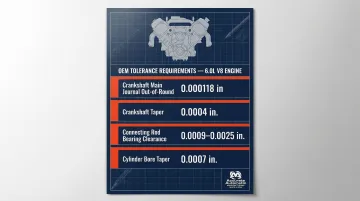
Engine components require extremely precise internal cavities, bore dimensions, and surface finishes. Even minor deviations affect engine balance, oil film integrity, and combustion efficiency. For example, OEM specifications for 6.0L V8 engines dictate:
- Crankshaft main journal out-of-round: Maximum 0.000118 inches
- Crankshaft taper: Maximum 0.0004 inches
- Connecting rod bearing clearance: 0.0009 to 0.0025 inches
- Cylinder bore taper: Maximum 0.0007 inches
These tolerances demand CNC turning operations followed by precision cylindrical grinding, rigid workholding to prevent deflection, and thermal compensation systems to maintain accuracy as machines heat up during long production runs.
Cylinder Heads and Blocks
Cylinder heads and engine blocks contain complex internal passages for coolant and oil flow, along with precision-bored cylinders that must maintain strict roundness and surface finish. CNC milling creates these 3D features with the positional accuracy required to ensure proper sealing, compression, and thermal management.
Valve Retainers and Carburetor Housings
Smaller engine components such as valve retainers and carburetor housings have tight tolerances that directly impact combustion efficiency and engine performance. CNC screw machine operations excel at producing these small, high-precision parts at the volumes automotive production demands.
Transmission and Drivetrain Components
Gears and Drive Shafts
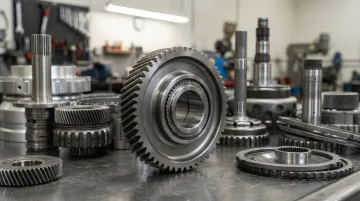
Transmission gears must meet stringent accuracy standards such as ANSI/AGMA 2015 and ISO 1328-1, typically requiring AGMA Class 9-10 quality for automotive applications. Gear tooth profiles, pitch accuracy, and surface finish directly affect noise, vibration, and harshness (NVH)—factors magnified in the near-silent cabins of electric vehicles.
CNC milling and turning operations, often followed by precision grinding or honing, achieve the required surface roughness of Ra 0.2–0.4 µm for high-speed automotive transmissions.
Bearing Housings
Bearing housings in transmissions and differentials require precise bore diameters and surface quality to prevent fretting corrosion and ensure proper load distribution. CNC boring operations deliver the dimensional control and surface finish needed for long service life under high dynamic loads.
Suspension, Steering, and Brake System Components
Steering Knuckles and Suspension Arms
Chassis components such as steering knuckles, suspension arms, and control arms have complex geometries and must withstand high dynamic loads during cornering, braking, and impact events. CNC machining ensures the dimensional accuracy and structural integrity required for vehicle stability and occupant safety. These components often require 5-axis machining to access all surfaces in a single setup, reducing tolerance stack-up and improving accuracy.
Brake Discs and Caliper Housings
Brake system components have strict flatness and dimensional requirements:
- Brake rotor lateral runout: Maximum 0.004 inches
- Brake rotor thickness variation: Maximum 0.0005 inches
Exceeding these limits causes pedal pulsation and inconsistent stopping performance. CNC turning and face milling operations achieve the required flatness, while precision boring ensures caliper pistons actuate smoothly without leaking. OEM specifications mandate that caliper bore polishing cannot increase bore diameter by more than 0.001 inches, which underscores how tight the initial machining tolerances must be.
Body, Lighting, and Interior Components
Structural Body Parts
CNC machining produces structural body components such as door hinges, frame reinforcements, and mounting brackets where dimensional consistency is essential for proper fit and crash performance. These parts often require multi-axis machining to access angled features and complex mounting surfaces.
Automotive Lighting Fixtures
Modern headlight and taillight assemblies increasingly use PMMA acrylic instead of glass due to its shatter resistance and optical clarity. PMMA offers 92% light transmittance, less than 0.5% haze, and a refractive index of 1.49, making it well-suited for automotive optics.
CNC machining PMMA demands careful attention to avoid thermal damage that would compromise optical clarity. Key process requirements include:
- Sharp tooling and controlled feeds and speeds to minimize heat generation
- Proper coolant application to manage heat buildup and prevent melting during cutting
- Deliberate toolpath programming to maintain surface quality throughout the cut
CNC Machining Processes Most Used in the Automotive Sector
CNC Machining Processes Most Used in the Automotive Sector
CNC Milling for Complex 3D Features
CNC milling is the most common automotive machining process, used to create complex 3D features, flat surfaces, and internal cavities in engine blocks, cylinder heads, transmission housings, and structural components. Three-axis milling handles most applications, while 5-axis machining is increasingly adopted for geometries that would otherwise require multiple setups.
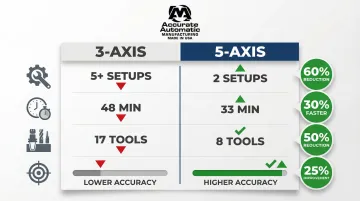
Measured Benefits of 5-Axis Machining
- Setups reduced: From more than 5 down to 2 (60% reduction)
- Cycle time reduced: From 48 minutes to 33 minutes (30% reduction)
- Tooling required: Cut from 17 tools to 8 tools (50% reduction)
- Process accuracy improved: 25% increase in dimensional control
These gains come from simultaneous movement across three linear axes (X, Y, Z) and two rotary axes. That combination lets 5-axis machines complete complex components in a single setup — eliminating tolerance stack-up from manual reclamping and achieving volumetric accuracy better than 30 µm.
CNC Turning and Mill-Turn Operations
CNC turning excels at producing cylindrical components — drive shafts, crankshafts, axle shafts, and bushings. Mill-turn machines consolidate turning and milling into a single platform, a clear advantage for automotive shafts and rotors that require both operations.
In practice, suppliers have used mill-turn technology to machine cooling channels into large rotor shafts in just two setups. That approach eliminates manual welding, improves vibration characteristics, and delivers 30% productivity gains.
Drilling and Boring for Precision Holes
Drilling and boring operations create precise holes, bores, and fluid passages in engine blocks, cylinder heads, and transmission components. Positional accuracy is critical — oil galleries and coolant passages must align exactly across mating surfaces to prevent leaks and ensure proper lubrication and thermal management.
In-process probing systems automatically locate parts and set machine offsets, ensuring features like keyways are machined dead-on center without manual touch-offs.
Materials Commonly Used in Automotive CNC Machining
Aluminum Alloys in Automotive Applications
Aluminum is the fastest-growing automotive material, driven by lightweighting demands. Average aluminum content per vehicle grew from 397 pounds in 2015 and is projected to reach 556 pounds by 2030. This growth concentrates in extrusions and castings for body-in-white components, crash management systems, suspension parts, and EV battery housings.
Its strength-to-weight ratio, machinability, and corrosion resistance make aluminum well-suited for automotive applications. High-volume machining, though, demands optimized tooling and high-pressure coolant systems to maintain throughput and tool life.
Steel and Stainless Steel for High-Stress Components
Components subjected to extreme fatigue and impact—such as crankshafts, connecting rods, transmission gears, and brake components—require specific alloy steels:
| Steel Grade | Tensile Strength | Hardness | Typical Application |
|---|---|---|---|
| AISI 4340 | 161,000 psi | 321 HB / 35 HRC | High-performance crankshafts and connecting rods |
| AISI 8620 | 168,000 psi | 341 HB / 61 HRC (case) | Carburized transmission gears and differentials |
| 300M | 280,000+ psi | 52-56 HRC | Ultra-high-strength motorsport applications |
These materials provide the hardness, tensile strength, and fatigue resistance required for components operating under continuous high loads and thermal cycling.
Specialty Materials: Titanium and Engineering Plastics
Titanium (specifically Ti-6Al-4V) is used in motorsport applications for valves, connecting rods, and suspension springs, offering up to 70% weight savings compared to steel.
That advantage comes with real machining constraints. Titanium's low thermal conductivity means up to 75% of cutting heat concentrates at the tool edge rather than dissipating into the chip — requiring high-pressure coolant, reduced cutting speeds, and specialized carbide grades to prevent rapid tool wear.
Engineering plastics and PMMA acrylics are used for electronic housings and lighting components.
CNC Machining for Electric Vehicles: The Next Frontier
EV Production Projections
The transition to electric vehicles is driving a massive reallocation of CNC machining resources. According to the International Energy Agency's Global EV Outlook 2024, electric light-duty vehicles are projected to capture 40% of total vehicle sales by 2030 under stated policies. This represents roughly 40 million annual EV sales globally, creating demand for precision-machined EV components at a scale the industry hasn't had to meet before.
Weight Reduction Directly Extends Battery Range
Lightweighting is especially critical for EVs because vehicle weight directly impacts battery range and cost. Studies show that reducing EV weight by 20% increases range by up to 14%. That reduction lets OEMs shrink the battery pack needed for the same range, cutting weight further. Aluminum alloy machining now accounts for a significant share of EV production CNC work as a result.
New EV Component Requirements
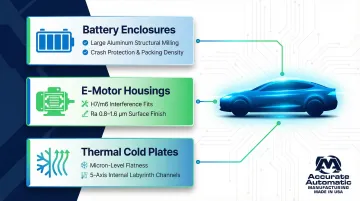
Electric vehicle architecture introduces components that demand the same precision tolerances as traditional powertrains:
- Battery enclosures: Large structural aluminum components requiring extensive milling to achieve maximum packing density and crash intrusion protection
- E-motor housings: Bearing seats must meet H7/m6 transition/interference fits with surface roughness of Ra 0.8-1.6 µm to prevent fretting corrosion at high RPMs
- Thermal management cold plates: Liquid cold plates mounted to battery modules require micron-level flatness tolerances to ensure efficient heat transfer and prevent coolant leakage; complex internal labyrinth flow channels require 5-axis CNC capabilities
CNC Finishing of 3D-Printed EV Components
Those component requirements don't stop at machined parts. Where 3D printing handles EV prototyping and select production parts, CNC machining finishes those printed components to the tight tolerances needed for safe, efficient vehicle performance. Bearing seats, mounting surfaces, and sealing faces on 3D-printed parts typically require CNC post-processing to achieve the dimensional accuracy and surface finish that EV applications demand.
Choosing the Right CNC Machining Partner for Automotive Parts
Prioritize Proven Automotive Experience
Automotive manufacturers and suppliers should prioritize machining partners with demonstrated experience in high-precision, complex component production—not just general-purpose machine shops. Automotive tolerances are uniquely demanding.
That means looking for expertise in thermal management, tooling strategies for difficult materials, and process control that consistently maintains capability indices (Ppk > 1.33) across long production runs.
Quality Culture and On-Time Delivery
Technical capability alone isn't enough. Look for partners with a strong quality culture, a commitment to superior workmanship, and a track record of on-time delivery. Supply chain disruptions in automotive manufacturing can cascade into production line shutdowns, making reliability non-negotiable. Accurate Automatic MFG, for instance, centers its operations on service, quality, and delivery—with customer relationships built on integrity rather than transactional convenience.
Multi-Capability Shops Reduce Lead Times
Seek machining partners who can handle a component from raw material to finished part under one roof. Consolidating operations within a single supplier delivers measurable advantages:
- Reduces handoffs between vendors, cutting coordination time
- Eliminates tolerance stack-up caused by multiple fixture setups
- Shortens overall lead times by keeping work in-house
- Simplifies quality control and end-to-end traceability
Frequently Asked Questions
What CNC machining processes are most commonly used in automotive manufacturing?
CNC milling, turning, and mill-turn operations are the most widely used processes. Milling creates complex 3D features in engine blocks and housings, while turning produces cylindrical components like shafts. 5-axis milling is increasingly common for complex geometries, and the choice depends on part geometry, material, and required tolerances.
What materials are most commonly CNC machined for automotive parts?
Aluminum alloys are most common due to their light weight and machinability, projected to reach 556 pounds per vehicle by 2030. Steel and stainless steel are used for high-stress components like crankshafts and gears, with titanium and engineering plastics reserved for specialty applications.
How does CNC machining support electric vehicle (EV) production?
EVs require precision-machined battery housings, motor components, and thermal management parts — often to the same tight tolerances as traditional powertrains. CNC machining also finishes 3D-printed EV components to spec and drives the lightweight aluminum work that matters: a 20% weight reduction extends EV range by roughly 14%.
What tolerances can CNC machining achieve for automotive parts?
Modern CNC machining centers achieve tolerances as tight as ±0.00006 inches (±0.0015 mm) with repeatability of ±0.00004 inches. This meets or exceeds the requirements for demanding automotive components like crankshaft journals and brake rotors.
Can CNC machining be used for both automotive prototyping and mass production?
Yes, CNC machining works well for both. It allows rapid iteration during prototyping with quick program changes, and once finalized, delivers consistent, repeatable parts at production scale. That same programmability suits high-mix/low-volume runs — a production model many automotive suppliers now rely on.
What is the difference between CNC milling and CNC turning for automotive applications?
CNC milling handles parts with complex 3D features and flat surfaces — engine blocks, cylinder heads, and transmission housings. CNC turning excels at cylindrical parts like shafts, crankshafts, and bushings. Mill-turn machines combine both in a single setup, cutting cycle times by 30% and eliminating tolerance errors from multiple fixturings.