Introduction
Automotive manufacturers face an unrelenting challenge: they must balance micron-level part tolerances, high production volumes, and non-negotiable safety standardswhile controlling costs. Traditional manual machining increasingly falls short. A single operator error on a crankshaft journal or brake caliper can cascade into warranty claims, assembly line shutdowns, or safety recalls.
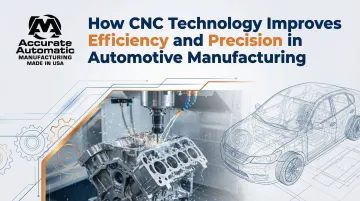
CNC (Computer Numerical Control) technology addresses this gap by using computer-aided design (CAD) software to control cutting tools with programmed precision. Instead of relying on manual dexterity, CNC machines execute pre-validated toolpaths that deliver consistent, repeatable results across every part in a production run—whether it's the first piece or the 10,000th.
What follows covers how CNC technology improves precision and efficiency across automotive manufacturing: the parts it produces, the techniques behind complex geometries, and emerging trends like AI-driven predictive maintenance and Industry 4.0 integration that are pushing CNC capabilities further.
Key Takeaways
- CNC machining achieves micron-level tolerances that manual methods cannot consistently replicate across high-volume runs
- Automation reduces cycle times, scrap rates, and labor costs while enabling 24/7 lights-out manufacturing
- Multi-axis CNC completes complex geometries in a single setup, eliminating fixturing errors
- Handles aluminum, steel, titanium, and advanced composites used in modern vehicle lightweighting programs
- AI, robotics, and Industry 4.0 integration are expanding what automotive CNC systems can automate and optimize
How CNC Technology Delivers Precision in Automotive Parts
Precision in automotive manufacturing means parts must meet exact dimensional specifications—often within microns—because deviations in components like engine blocks or brake calipers directly impact vehicle safety and performance. A crankshaft journal that's 15 microns out of round can cause premature bearing failure; a brake caliper bracket with misaligned mounting holes can compromise stopping power.
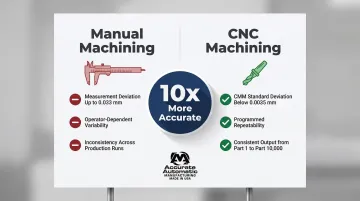
CNC machines use programmed instructions to guide cutting tools along predetermined paths, eliminating the variability inherent in manual operation. Automated Coordinate Measuring Machines (CMMs) maintain standard deviations below 0.0035 mm, while manual calipers fluctuate up to 0.033 mm—a tenfold difference that separates acceptable parts from scrap.
Once a CNC program is set and validated, every subsequent part—whether it's the 1st or the 10,000th—meets the same exact specifications. That repeatability is what makes CNC indispensable on automotive assembly lines, where interchangeable parts must fit together without hand-fitting or rework.
Governing Standards and Tolerances
Automotive precision is strictly governed by international standards:
| Standard | Application | Automotive Relevance |
|---|---|---|
| ASME Y14.5-2018 | Geometric Dimensioning & Tolerancing | Defines theoretical perfect geometry and allowable variation for part interchangeability |
| ISO 286 (H7/h6) | Limits and Fits | Dictates clearance/interference fits for cylindrical features like transmission shafts |
| ISO/TR 27507 | Plain Bearings / Crankshafts | Recommends diametral tolerances of 13 µm for journals; out-of-round limits of 5-12.5 µm |
Meeting these standards in practice comes down to which machining process handles each component type:
- CNC turning controls tight tolerances on cylindrical components like shafts and bearings, ensuring parts fit together exactly as designed and reducing premature wear
- CNC milling achieves precise flat surfaces, grooves, and complex contours essential for transmission housings and brake system frames, where surface-to-surface fit and sealing are critical
Key Efficiency Gains CNC Machining Brings to Automotive Production
CNC automation eliminates constant manual operator intervention during machining. A single machine can execute complex multi-step processes—drilling, milling, turning—with minimal downtime between operations. Reduced setup time and fewer manual adjustments translate directly to faster production cycles.
The "Lights-Out" Multiplier
Facilities deploying automated pallet pools and robotic tending report tangible gains. Okuma's Dream Site 2 factory achieved 30% higher productivity and 30% lower energy use by running small-batch lathes and grinders 24/7 with a skeleton staff. Similarly, a precision shop running RoboDrill cells unattended for 16 hours daily and completely lights-out on weekends effectively doubled machining capacity and tripled throughput.
Waste Reduction Through Optimized Tool Paths
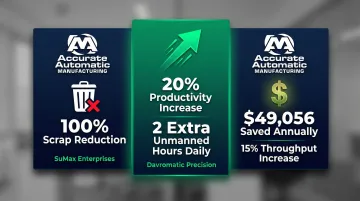
Because CNC tool paths are optimized through CAM (Computer-Aided Manufacturing) software before cutting begins, material removal is precise and scrap rates drop significantly compared to manual machining. SuMax Enterprises experienced a 12% scrap rate on automotive pump body castings when relying solely on mechanical fixtures. By implementing automated on-machine probing for part location prior to machining, they eliminated scrap entirely: a 100% reduction. That shift saved $49,056 annually and increased throughput by 15%.
Downstream Cost Reductions
CNC's consistency reduces downstream costs in multiple ways:
- Cuts rework and inspection overhead by producing fewer defective parts
- Reduces warranty claims tied to dimensional inconsistencies in the field
- Lowers total cost per part over time, offsetting upfront technology investment
- Catches deviations in real-time through automated in-process inspection, preventing full batch rejections
These gains are measurable in practice. Davromatic Precision implemented touch probing systems on sliding-head CNC lathes for 100% real-time inspection of critical dimensions, resulting in a 20% productivity increase, a 10% reduction in scrap, and two additional hours of unmanned running per day.
CNC Machining Techniques Used in Automotive Manufacturing
CNC Milling for Flat Surfaces and Complex Geometries
CNC milling uses rotating multi-point cutting tools to remove material from a workpiece, creating flat surfaces, slots, holes, and complex 3D contours. These operations are critical for components like:
- Engine housings and intake manifolds
- Transmission casings and valve bodies
- Suspension brackets and mounting plates
CNC milling's capacity to cut intricate internal passages for coolant and oil distribution makes it indispensable for powertrain components.
CNC Turning for Cylindrical Automotive Components
CNC turning rotates the workpiece against a stationary cutting tool to produce smooth, precise cylindrical shapes. This technique is ideal for:
- Crankshafts and camshafts
- Drive axles and wheel hubs
- Bearing journals and fasteners
Dimensional accuracy and surface finish affect performance and longevity. A poorly turned bearing surface will generate excess friction, heat, and premature wear.
Multi-Axis Machining for Complex Parts
4-axis and 5-axis CNC machining allows the cutting tool and/or workpiece to move along multiple planes simultaneously, enabling highly complex geometries in a single setup. This reduces fixturing errors and improves accuracy for parts like:
- Turbocharger housings with compound curves
- Exhaust manifolds with multiple ports
- Suspension knuckles with angled mounting surfaces
Evans Industries reduced machining time of a complex billet part from 23 hours to 13 hours by using 5-axis DMG MORI machines paired with advanced CAM strategies and conical barrel cutters.
CAD/CAM Integration and Pre-Production Simulation
Managing that geometric complexity requires more than advanced hardware. Modern CNC operations integrate CAD design with CAM software to simulate the entire machining process before a single cut is made. This digital validation:
- Detects tool collisions and kinematic errors
- Optimizes tool paths for efficiency
- Validates tolerances digitally
- Prevents costly material waste during actual production
Joe Gibbs Racing used Siemens NX digital twins to consolidate a three-piece suspension draglink into a single machined part, reducing cycle time by one hour and slashing setup time from 42 hours to 9.5 hours—a 77% reduction that saved $1,117 per part.
Common Automotive Parts Produced with CNC Machining
CNC machining covers virtually every vehicle system, producing parts where dimensional accuracy directly affects performance and safety:
Powertrain Components
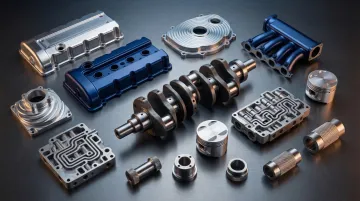
Engine blocks, cylinder heads, crankshafts, and transmission casings must withstand extreme heat, pressure, and mechanical stress. Tolerances often reach ±0.005 mm to ±0.01 mm to ensure perfect surface finishes and internal channels for coolant and oil flow.
Chassis and Safety System Components
Steering knuckles, suspension arms, brake calipers, and wheel hubs are safety-critical — CNC's repeatability ensures every piece meets stringent quality standards. Brake caliper brackets, for example, must maintain ±0.005 mm tolerances for heat resistance and structural rigidity.
Interior and Drivetrain Components
Gearbox housings, differential cases, and pedal assemblies benefit from CNC's material flexibility. The same operation can handle aluminum for lightweight applications, steel for high-strength structures, and brass for corrosion-resistant fittings — without changing facilities or compromising consistency.
| Vehicle System | Common CNC Parts | Key Requirements |
|---|---|---|
| Powertrain (ICE) | Engine blocks, cylinder heads, crankshafts | ±0.005-0.01 mm tolerances; perfect surface finishes |
| Drivetrain | Gear shafts, differential housings, transmission covers | Tight geometric alignment; ±0.01 mm precision |
| Chassis & Steering | Control arms, steering knuckles, spindles | High fatigue resistance; complex 3D geometries |
| Brakes & Safety | Caliper brackets, master cylinders, ABS housings | Non-negotiable consistency; ±0.005 mm tolerances |
| EV Specific | Battery casings, motor cooling plates, sensor brackets | Excellent dimensional control for thermal management |
Materials CNC Machines Handle for Automotive Applications
CNC machining adapts to a wide range of automotive materials without retooling entire production lines. Each material brings its own machining demands:
- Aluminum (6061, 7075) — Dominates cylinder heads, transmission housings, and battery enclosures. High cutting speeds and proper coolant strategies are essential to prevent chip welding.
- Steel (4140 alloy, forged steel) — The go-to for crankshafts, gears, and structural components. Harder grades require slower speeds, robust tooling, and careful chip evacuation.
- Brass — Well-suited for fittings, bearings, and valve components. Machines quickly with minimal tool wear thanks to its natural machinability.
- Titanium alloys — Reserved for high-performance applications where strength-to-weight ratio is critical. Specialized cutting parameters are needed to manage heat buildup.
- Engineering plastics (POM, ABS, Nylon) — Common in sensor housings, interior trim, and lightweight brackets. Sharp tooling prevents heat-related melting during cutting.
The EV Aluminum Surge
The transition to electric vehicles is accelerating aluminum adoption to offset battery weight. Average North American vehicle aluminum content reached 459 lbs in 2020 and is projected to increase to 514 lbs by 2026 and 570 lbs by 2030. While BEVs eliminate approximately 200 lbs of ICE-specific aluminum parts, they add over 400 lbs via battery housings, motor cases, and structural extrusions.
The Future of CNC Machining in Automotive Manufacturing
Industry 4.0 and Smart Manufacturing Integration
Sensors embedded in CNC machines provide real-time data on tool wear, temperature, and vibration. This data feeds into Manufacturing Execution Systems (MES) to enable predictive maintenance, reduce unplanned downtime, and optimize cutting parameters automatically. A 2025 Deloitte survey found that smart manufacturing investments yielded up to 20% improvement in production output and 15% gains in unlocked capacity.
AI and Machine Learning in CNC Programming
AI systems analyze production data to refine tool paths, detect anomalies early, and adjust parameters mid-run without operator input. AI-driven predictive maintenance reduces unplanned downtime by 30-50% and delivers a 10:1 to 30:1 ROI within 12-18 months. This pushes precision and uptime even further, enabling manufacturers to maintain tighter tolerances with less human intervention.
The Outsourcing Boom
Automotive manufacturers are increasingly outsourcing precision CNC machining to specialized shops that invest in advanced multi-axis equipment and skilled programmers. The global precision machining market is projected to grow at an 8.1% CAGR to reach $228.75 billion by 2033, driven largely by automotive demand.
This trend allows OEMs and Tier 1 suppliers to focus on design and assembly while trusting precision partners—like Accurate Automatic MFG—for complex component production. These shops offer capabilities that would require significant capital investment to replicate in-house, including:
- 5-axis machining for complex geometries
- Digital twin simulation to validate programs before cutting
- Automated quality control for consistent, documentable results
Frequently Asked Questions
What types of automotive parts are commonly made with CNC machining?
CNC machining produces a wide range of automotive components—from powertrain parts like engine blocks and crankshafts to safety-critical components like brake calipers, suspension arms, steering knuckles, and EV battery enclosures. Any metal or plastic part requiring tight tolerances is a strong candidate for CNC production.
How does CNC machining maintain consistency across large production runs?
Once a CNC program is validated, it controls every cut identically regardless of run length, eliminating operator variability. The 10,000th part meets the same specifications as the first because the machine executes the exact same toolpath with the same feeds, speeds, and cutting depths every time.
What materials can CNC machines work with for automotive parts?
CNC machines handle aluminum, steel, brass, titanium, and engineering plastics. CNC's programmability allows cutting parameters—speeds, feeds, coolant strategies—to be tailored to each material's properties, supporting everything from lightweight aluminum battery housings to hardened steel crankshafts.
How does multi-axis CNC machining benefit complex automotive component production?
Multi-axis (4- and 5-axis) machining completes complex geometries in a single setup, reducing fixturing errors and achieving tighter tolerances. Parts like turbocharger housings and exhaust manifolds—with compound curves and undercuts—that would otherwise need multiple 3-axis setups are finished in one operation.
Is CNC machining cost-effective for automotive manufacturers?
CNC carries higher upfront programming costs, but reduces per-part cost at scale through automation, lower scrap rates, and faster cycle times. Lights-out operation and reduced inspection overhead make it cost-effective for both medium and high-volume runs.
How does CNC technology compare to traditional manual machining for automotive applications?
CNC delivers micron-level tolerances, faster throughput, and 24/7 operational capability that manual machining cannot replicate. Studies show manual methods produce measurement errors up to 10 times higher than automated systems—a gap that disqualifies manual cutting for most automotive precision requirements.