Introduction
Manufacturers today face mounting pressure: tighter tolerances, faster production cycles, and component geometries that grow more complex with every product generation. No single technology handles all of that alone. Precision CNC machining and industrial robotics are strongest when they work together — each making the other more capable.
Precision CNC machining produces the high-tolerance components that allow robots to move accurately and reliably. Robotic automation, in turn, transforms how machine shops operate — improving throughput and freeing skilled operators for higher-value work.
This article covers:
- How CNC machining and robotics form a two-way relationship
- The critical components precision machining produces for robotic systems
- How automation improves shop floor efficiency
- What the future holds for this partnership
Key Takeaways
- Precision CNC machining enables robotics by producing sub-micron tolerance components—such as harmonic drive gears, robotic joints, and actuator housings—with the accuracy robots demand
- Robotic automation pushes shop OEE from 70% to 95%, enables lights-out production, and drives scrap rates toward zero
- Surgical robotics, space systems, and humanoid robots are pushing tolerance requirements tighter than ever
- AI-driven adaptive machining and collaborative robots are creating smarter, more flexible manufacturing ecosystems
The Symbiotic Relationship Between CNC Precision Machining and Robotics
Precision CNC machining and robotics share a bidirectional dependency. CNC machining is the foundational process that makes modern robotics possible—robots are only as reliable as the parts inside them. Simultaneously, robotic automation is increasingly deployed within CNC machining environments to improve output and consistency.
What Precision CNC Machining Actually Means
Precision CNC machining refers to computer numerically controlled material removal processes capable of holding tolerances measured in microns. While standard CNC machining typically achieves tolerances of ±0.005" (0.127 mm), precision machining operates at ±0.001" (25.4 μm) or tighter, often reaching sub-micron levels for critical applications. This level of accuracy is non-negotiable for robotic applications, where even minor dimensional deviations cascade into system-level failures.
Why Robotics Manufacturers Rely on Precision Machine Shops
The International Federation of Robotics (IFR) reports 542,000 industrial robots installed globally in 2024, bringing the operational stock to 4.66 million units. Each robotic system depends on hundreds of custom-machined components, each with distinct geometry, material requirements, and tolerance specs that standard machining cannot reliably hit.
Components where precision machining is non-negotiable include:
- Joint actuator housings — misalignment errors compound across multi-axis movement
- Encoder mounting brackets — positional feedback accuracy depends on dimensional consistency
- Gear reduction assemblies — backlash tolerances measured in arc-seconds require sub-micron fits
- End-effector tooling interfaces — interchangeability demands repeatable true position across batches
How Robotics Is Reshaping the CNC Shop Floor
Machine shops are deploying the same robotic technology they supply components for. Robotic arms handle machine tending and part-loading, freeing operators for higher-skill tasks. Closed-loop inspection systems catch dimensional drift before it becomes scrap.
The result is measurable: automated tending typically reduces per-part cycle time by 20-30% while keeping spindle utilization above 85% across lights-out shifts. Digital integration through protocols like MTConnect and OPC UA connects CAD/CAM data, real-time sensor feeds, and shop floor equipment into a single responsive system — each layer making the next one more effective.
Critical Robotic Components That Require Precision CNC Machining
Robotics demands machined parts across motion, sensing, gripping, and structural support—each with distinct precision requirements that define overall robot performance.
Robotic Joints and Harmonic Drive Gears
Harmonic drives (strain wave gears) are the heart of most robotic joints due to their zero-backlash and high-torque capabilities. These assemblies consist of three components: the Wave Generator, Flexspline, and Circular Spline. Manufacturing these parts demands extreme precision.
Tolerance Requirements:
Harmonic Drive LLC mandates strict assembly tolerances:
- Wave Generator shaft tolerance: h6
- Housing surface tolerance: H7
- Concentricity tolerance: 0.011 mm (Size 14) to 0.016 mm (Size 32)
- Perpendicularity tolerance: 0.008 mm to 0.022 mm
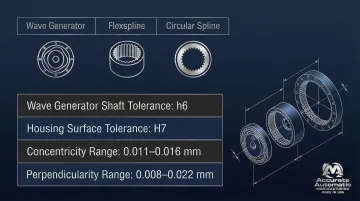
Any deviation in gear geometry translates directly into positional inaccuracy. When CNC machined housings fall outside concentricity and perpendicularity tolerances, the harmonic drive suffers geometric misalignment.
Improper Wave Generator alignment causes teeth between the Circular Spline and Flexspline to engage incorrectly—a phenomenon known as "dedoidal" ratcheting. This abnormal meshing produces severe vibration, torque ripple, and premature fatigue fracture of the flexible wheel.
End Effectors and Actuator Housings
End effectors—the "hands" of robots—must be machined to precise internal dimensions to ensure reliable gripping force, tool alignment, and interchangeability. In automated assembly and surgical robotics, sub-millimeter accuracy is critical.
Gripper Repeatability Benchmarks:
- Robotiq 2F-85 adaptive gripper: ±0.05 mm (0.002 in) positional repeatability
- OnRobot RG2: ±0.1 mm positional repeatability
The actuators driving those end effectors place equally demanding requirements on their housings. Actuator housings must be machined to exact bore sizes and surface finishes to ensure proper fit, minimize vibration transmission, and withstand operational loads over thousands of cycles.
For PTFE composite bearings, SKF engineering standards dictate surface roughness (Ra) should not exceed 0.4 μm — and no greater than 0.3 μm in highly demanding applications.
Sensor Housings and Structural Frames
Sensor integration in modern robots—force sensors, encoders, vision systems—requires precision-machined housings that position sensors in exact orientations. Sensor misalignment, even by fractions of a degree, corrupts feedback data and degrades robot control.
Structural frames and base plates require flatness, parallelism, and precise hole placement to ensure the entire robot assembly maintains geometric integrity under dynamic loads. Even heavy-payload industrial robots like the KUKA KR QUANTEC (120–300 kg capacity) must maintain repeatability within ±0.05 mm, proving that underlying machined castings and gearboxes must be manufactured to near-perfect tolerances.
How Automation and Robotics Are Transforming CNC Manufacturing Efficiency
Robotic automation is being adopted within precision machine shops to improve throughput, quality consistency, and operational capacity—including the ability to run production overnight or on weekends without direct human oversight.
Robotic Machine Tending and Lights-Out Manufacturing
Robotic machine tending involves industrial robots programmed to load raw stock, retrieve finished parts, and transfer workpieces between operations. Robotic machine tending involves industrial robots programmed to load raw stock, retrieve finished parts, and transfer workpieces between operations, freeing CNC operators from repetitive handling tasks and enabling machines to run continuously.
Real-world results from early adopters demonstrate the impact:
- EMI Integrated Systems boosted OEE from 70% to 95% using Universal Robots (UR5 and UR10), adding 1,200–1,600 production hours per machine annually with ROI in 12–18 months
- Dimension Machine increased daily output by 40–60% after deploying an AWR Flex Series tending cell
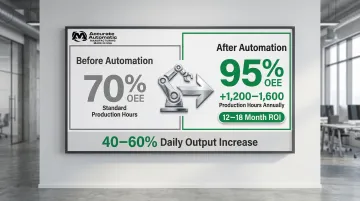
Lights-out manufacturing refers to automated CNC environments where production continues with minimal or no human presence during off-hours, increasing effective machine utilization rates and reducing per-part costs for high-volume runs.
Automated Quality Control and In-Process Inspection
Robotic arms integrated with CMM probes or vision systems perform in-process and post-process inspection, catching dimensional deviations in real time rather than after a full batch has been produced.
Robotic arms integrated with CMM probes or vision systems perform in-process and post-process inspection, catching dimensional deviations in real time rather than after a full batch has been produced.
Documented results from probe-based inspection systems:
- Renishaw probing at Vasantha Tool Crafts cut tool offset times by 80%
- A Primo twin-probe system at SuMax Enterprises dropped scrap rates from 12% to 0% by eliminating wall thickness variation
Combining CNC precision with automated inspection creates a self-correcting production environment: the system detects drift in tool wear or thermal expansion and feeds corrections back to the CNC program, maintaining consistent tolerances across long production runs.
Flexible Automation for Mixed-Part Production
Modern flexible robotic cells, equipped with quick-change tooling and programmable handling, allow machine shops to automate production of smaller batch sizes and varied part geometries, not just high-volume identical parts.
Key strategies for High-Mix, Low-Volume (HMLV) automation:
- Quick-change fixturing reduces setup time from hours to minutes while maintaining micron-level positioning
- Adaptive grippers allow a single robot to handle multiple part geometries without tool changes
- Autonomous bin picking uses 3D vision to identify and pick randomly oriented raw materials, eliminating structured trays
North American robot orders rose 6.6% in 2025, with 36,766 robots valued at $2.25 billion ordered. Demand from non-automotive customers outpaced automotive demand — a sign that smaller shops are treating automation as a direct response to labor constraints and capacity ceilings, not just a large-factory advantage.
Key Benefits of Precision CNC Machining for Robotic Systems
Accuracy and Repeatability
CNC machining's ability to produce parts to the same specification, batch after batch, is what makes robotic systems reliable at scale. Inconsistent components are a leading cause of robotic system failures in the field. Modern CNC equipment routinely achieves positioning repeatability within 0.0005 mm (0.5 μm).
Material Versatility
Precision CNC machining works across materials critical to robotics:
- Titanium and aluminum alloys for lightweight structural parts
- Stainless steel for corrosion-resistant components
- Engineering plastics for non-conductive housings
This gives design engineers significant flexibility. Accurate Automatic MFG supports this range through CNC milling, CNC turning, and screw machine operations — handling material transitions without requiring separate vendors.
Scalability from Prototype to Production
CNC machining supports robotics development at every stage, from one-off prototype joints in R&D to full production runs of standardized components for commercial assembly. Tooling changeover is minimal compared to most alternative manufacturing processes, which keeps lead times short as volume scales up.
The Future of Precision Machining and Robotic Automation
AI and Machine Learning Integration
AI is being embedded in CNC machining environments—predicting tool wear, optimizing cutting parameters in real time, and detecting anomalies before they cause defects. FANUC's real-time adaptive control monitors spindle power to detect varying cutting conditions; if tool wear increases, the feedrate is automatically reduced. In tests, this adaptive control reduced cycle times by more than 40%.
TEMCO Tool implemented FANUC's MT-LINKi software for automated machine tool data collection and analysis. By using this data to optimize machining, production throughputs nearly doubled, and the performance of a specific ROBOCUT machine increased by 200%.
Cobots and Human-Robot Collaboration on the Shop Floor
Collaborative robots (cobots) designed for safe interaction with human workers are being deployed alongside CNC operators to handle material movement, part inspection, and repetitive secondary operations. Collaborative robot orders totaled 7,212 units in 2025, representing 19.6% of total robots ordered.
Cobots augment human skill rather than replace it. Their ease of programming, lower cost, and ability to work safely alongside operators without extensive guarding make them well-suited for high-mix, low-volume shops with limited floor space.
Next-Generation Robotic Applications Driving Tighter Precision Demands
Emerging robotic applications are pushing tolerance requirements even tighter:
- Surgical robots: FDA-regulated systems must meet IEC 80601-2-77 standards; the da Vinci Xi achieves mean positioning errors of ~2 mm after kinematic calibration
- Space robotics: The Canadarm2 on the ISS manages 116,000 kg payloads, demanding precision and dexterity in microgravity conditions
- Humanoid robots: Mass production of power-dense actuators for platforms like Boston Dynamics' Atlas requires aerospace-grade tolerances at commercial volumes
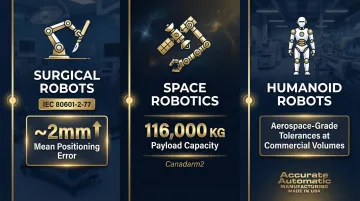
For precision contract manufacturers, these demands translate directly into tighter inspection requirements, expanded 5-axis and micro-EDM capabilities, and closer collaboration with engineering teams during part qualification.
Frequently Asked Questions
What is the difference between precision CNC machining and standard CNC machining?
Precision CNC machining holds significantly tighter tolerances—typically ±0.001" (25.4 μm) or less, often reaching sub-micron levels—using advanced equipment, programming, and quality control. Standard CNC machining typically targets tolerances of ±0.005" (0.127 mm) for less demanding applications.
What types of robotic components are produced using precision CNC machining?
Key categories include harmonic drive gears, robotic joints, end effectors, actuator housings, sensor mounts, and structural frames. All require tight tolerances (often within microns) and precise surface finishes to ensure robot performance and longevity.
How does robotic automation improve efficiency in a CNC machine shop?
Robots handle machine tending, part handling, and quality inspection, which cuts idle machine time and enables lights-out production runs. Skilled operators shift focus to programming, setup, and oversight. Shops typically see OEE climb from 70% to 95%, with ROI in 12-18 months.
What tolerances can precision CNC machining achieve for robotic applications?
Modern CNC machining holds tolerances of ±0.001" or tighter, with specialized processes such as grinding or honing reaching sub-micron levels (0.5 μm positioning repeatability). The achievable tolerance depends on the material, geometry, and equipment used.
Which industries beyond robotics benefit from precision CNC machining?
Aerospace, medical devices, defense, and semiconductor equipment manufacturing all depend on the same high-accuracy, repeatable components that precision CNC machining delivers. The global precision machining market was valued at $123.54 billion in 2025.
How do I choose the right precision machining partner for robotic component manufacturing?
Prioritize shops with proven tight-tolerance experience, multi-axis CNC capabilities, rigorous quality inspection, and a reliable delivery record. Confirm they can scale from prototype to full production and offer engineering support for design optimization.