Introduction
The energy sector — spanning oil and gas, renewable power, and traditional generation — operates under some of the harshest physical conditions on earth. Downhole drilling subjects components to pressures exceeding 20,000 psi. Gas turbines run at inlet temperatures reaching 1,600°C. Offshore platforms endure relentless saltwater corrosion and mechanical stress.
Component failures in these environments carry catastrophic consequences. Unplanned outages cost industrial facilities between $125,000 and $500,000 per hour, and offshore platforms lose an average of $38 million annually due to downtime.
CNC precision machining has become the manufacturing backbone of energy infrastructure for exactly this reason. When micron-level dimensional deviations can trigger equipment failure or safety incidents, the computer-controlled accuracy of CNC machining isn't optional.
This article covers why precision matters in energy manufacturing, where CNC machining is applied across energy sub-sectors, the measurable benefits it delivers, and what to look for in a machining partner.
TLDR:
- Unplanned energy equipment failures cost $125,000 to $500,000+ per hour; CNC precision prevents catastrophic downtime
- Components face 20,000 psi pressures and 1,600°C temps — micron-level accuracy is critical
- CNC machining produces safety-critical parts across oil/gas, wind, solar, nuclear, and hydroelectric sectors
- Tight tolerances (±0.001" or better) ensure proper fit, prevent leaks, and meet API, ASME, and NRC compliance standards
- Partner selection should prioritize documented quality processes, material traceability, and proven energy-sector experience
What Is CNC Precision Machining?
CNC (Computer Numerical Control) machining is a subtractive manufacturing process in which computer-programmed software directs cutting tools — mills, lathes, drills, grinders — to remove material from a solid workpiece and produce parts with exact, repeatable dimensions. Unlike manual machining, where human operators control cutting depth and tool paths, CNC systems execute pre-programmed instructions with mechanical consistency across hundreds or thousands of production cycles.
Precision CNC machining specifically refers to holding extremely tight dimensional tolerances — often within microns (0.001 inches or tighter) — across repeated production runs. Standard commercial machining typically works to ±0.005", which is adequate for many applications. In safety-critical energy infrastructure, however, those margins aren't enough.
Consider what's at stake:
- A valve seat sealing against 15,000 psi requires consistent surface geometry every time
- A turbine blade operating at 1,600°C must maintain exact airfoil dimensions to prevent failure
- Tolerances of ±0.001" or better become mandatory, not optional
That combination of accuracy and batch-to-batch repeatability is why precision CNC machining is the standard for energy component manufacturing.
Why Precision Is Non-Negotiable in Energy Manufacturing
Operating Extremes Demand Dimensional Perfection
Energy components endure physical conditions that push materials and manufacturing tolerances to their limits:
- High pressures: Downhole drilling equipment and wellhead systems contain pressures up to 20,000 psi per API 6A standards
- Extreme temperatures: Modern J-class and H-class gas turbines operate at turbine inlet temperatures of 1,600°C (2,912°F)
- Constant mechanical stress: Wind turbine drivetrains experience dynamic loading on multi-megawatt rotating assemblies
- Corrosive exposure: Offshore platforms face relentless saltwater and chemical attack on metal surfaces
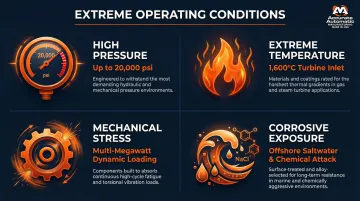
Even minor dimensional deviations — a valve seat machined 0.002" out of spec, a bearing housing with 0.003" run-out — can cause catastrophic equipment failure in these environments.
The Cascading Costs of Component Failure
When precision fails in energy systems, the financial and safety consequences cascade. Unplanned outages cost industrial facilities $125,000 per hour on average, with 69% of plants experiencing unplanned outages at least monthly. For complex equipment, costs can reach $500,000 per hour. In offshore oil and gas, platforms experience 27 days of unplanned downtime annually, costing $38 million in lost production.
These figures don't include emergency repair costs, regulatory penalties, or the safety incidents that accompany component failures in high-risk environments. Precision machining is an investment measured in thousands of dollars; a failed valve body or fractured turbine shaft is measured in millions.
Tight Tolerances Translate Directly to System Performance
Dimensional accuracy isn't just about preventing failure — it drives operational efficiency:
- Turbine blades machined to precise airfoil profiles convert more thermal energy to mechanical work
- Valve bodies with tight-fitting seats prevent pressure leaks and blowouts in wellhead systems
- Bearing housings machined to IT6/IT7 tolerances ensure proper load distribution and prevent premature wear
Each of these gains compounds across a system — a turbine running at peak aerodynamic efficiency while its bearings operate within spec produces measurably more output with less wear.
Repeatability Ensures Batch-to-Batch Consistency
Tolerances matter at the part level, but large energy projects demand that same precision across hundreds or thousands of components. A wind farm with 50 turbines needs main shafts, hubs, and gearbox housings that are dimensionally interchangeable. An offshore platform needs valve bodies and flanges that seal reliably regardless of which unit is installed.
CNC machining's computer-controlled repeatability makes this consistency achievable at scale. Once a part program is validated, the machine reproduces it identically across any production volume — something manual or less automated methods cannot guarantee.
Safety and Regulatory Compliance Require Documented Accuracy
Energy sector components must meet strict standards:
- API 6A for wellhead and pressure control equipment
- ASME NQA-1 and 10 CFR 50 Appendix B for nuclear safety-critical parts
- ISO 29001 for petroleum and natural gas supply chains
- ASME Y14.5 for geometric dimensioning and tolerancing
CNC precision machining provides the documented, measurable accuracy needed to demonstrate compliance during inspections and audits. Every dimension can be verified, every tolerance proven, every material lot traced — creating the unbroken chain of custody that regulators and safety protocols demand.
CNC Precision Machining Applications in the Energy Sector
CNC precision machining powers every major energy sub-sector. Below is a breakdown of where these components are critical and what they must withstand.
Oil and Gas
The oil and gas industry demands some of the most extreme precision machining in energy manufacturing. Critical CNC-machined parts include:
- Downhole drilling tools and heavy-weight drill pipe
- Valve bodies, bonnets, and pressure control equipment
- Threaded connectors and tool joints
- Wellhead components and Christmas tree assemblies
These parts must withstand pressures up to 20,000 psi and abrasive conditions deep underground. API Specification 6A mandates exceptionally smooth surface finishes — for example, all 23° surfaces on API 6BX ring gaskets must achieve Ra 0.8 µm (32 µin RMS) or better to prevent leakage at extreme pressures.
Machining these components from tough alloys like Inconel or duplex stainless steel requires rigid setups, high-performance carbide tooling, and strict process controls.
Wind Energy
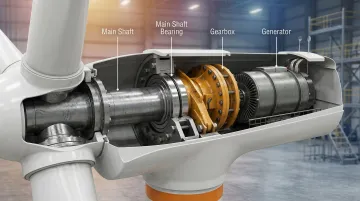
Wind turbine manufacturing relies on CNC machining for large, heavy rotating components where efficiency depends on tight geometric tolerances:
- Precision-machined hubs and main shafts
- Gearbox housings and bearing seats
- Pitch control components
- Nacelle structural parts
Global wind capacity additions hit a record 117 GW in 2023, driving massive demand for drivetrain components. Misalignment or unequal load sharing in 3-point mount spherical roller bearings can lead to micro-pitting and premature failure, costing up to $450,000 per replacement. To prevent this, shaft seats must be machined to IT6 dimensional tolerances and IT5 total run-out tolerances, while housing seats require IT7 dimensional and IT6 run-out tolerances per ISO 286 and ISO 1101 standards.
Solar Energy
Solar tolerances are generally less extreme than those in turbines or downhole tools — but precision still matters. CNC machining produces the structural and mechanical components that enable solar installations:
- Mounting brackets and frames
- Tracking system components and slew drives
- Panel support structures
- Actuator housings and bearing blocks
Tracking errors of just 1 to 3 degrees can result in 2% to 10% annual energy yield losses due to row-to-row shading during backtracking. Tight tolerances on slew drives and actuator housings eliminate mechanical backlash and ensure precise tracking accuracy.
Power Generation (Nuclear, Gas, Coal)
Traditional power generation relies on CNC precision machining for hot-gas-path and pressure-boundary components:
- Turbine blades and rotor assemblies
- Heat exchanger components
- Pump housings and impellers
- High-pressure piping systems
In nuclear applications, dimensional accuracy and material traceability are safety-critical — not optional. The U.S. Nuclear Regulatory Commission's 10 CFR 50 Appendix B requires traceable identification — by heat number, part number, or serial number — through fabrication and installation. ASME NQA-1 provides the quality assurance framework for these programs, requiring strict control of non-conforming items and documentation.
Hydroelectric and Geothermal
Hydroelectric and geothermal applications extend CNC precision machining into continuous-duty, high-stress environments:
- Hydroelectric: Turbine blades, casings, and shaft assemblies that must function reliably under constant high-flow water pressure
- Geothermal: Heat exchangers and pump components that operate in extreme underground temperatures and corrosive geothermal fluids
In both cases, tight tolerances directly translate to reduced maintenance intervals and longer component service life.
Key Benefits of CNC Precision Machining for Energy Components
Precision and Accuracy
CNC machines can hold tolerances as tight as a few microns (±0.001" or better), ensuring that every component — from a valve seat to a turbine shaft — meets exact specifications. This prevents misfit, leaks, vibration, and premature wear in assembled energy systems. The difference between a valve that seals at 15,000 psi and one that leaks catastrophically is often measured in thousandths of an inch.
Material Versatility
Energy applications demand a wide range of materials based on operating environment:
- Stainless steel (316L): Corrosion resistance in offshore and marine environments
- Titanium (Ti-6Al-4V): High strength-to-weight ratio for downhole tools and turbine blades
- Inconel 718/625: High-temperature strength for gas turbine hot-gas-path components operating at 1,600°C
- Alloy steels (4130/4140): High hardenability for API 6A valve bodies and pressure-containing equipment
- Engineering plastics: Non-metallic sealing and insulation applications
CNC machining handles this full spectrum, allowing manufacturers to select the optimal material for each operating environment without sacrificing precision or manufacturability.
Repeatability and Scalability
Once a part program is established and validated, CNC machines reproduce it identically across any production volume — from a single prototype to thousands of production parts. Whether you need 10 valve bodies for a pilot project or 1,000 for a full offshore platform build, dimensional consistency holds — no recalibration, no quality drift.
Reduced Waste and Cost Efficiency
Because CNC machining removes only the material necessary to achieve the final geometry, it minimizes raw material waste — a measurable advantage over casting or manual machining. Reduced rework and scrap rates from first-pass accuracy drive down per-part costs, which matters considerably on large-scale infrastructure projects where component counts run into the thousands.
Improved Safety and Reduced Downtime
Consistently precise components fail less frequently. CNC-manufactured parts reduce unplanned maintenance intervals in the field, improving operational uptime and cutting the safety incidents that come with component failure in high-risk environments. When critical parts are machined to spec the first time, the entire system runs more safely — and stays running longer.
Materials and Tolerances for Energy-Grade CNC Parts
Common Materials and Selection Criteria
Material selection is driven by the operating environment:
| Material | Primary Application | Max Operating Temp | Key Characteristic |
|---|---|---|---|
| Inconel 718 | Gas turbines, high-temp fasteners | 1,300°F (704°C) | High creep/rupture strength |
| Ti-6Al-4V | Downhole tools, turbine blades | 660°F (350°C) | High strength-to-weight ratio |
| 316L Stainless | Offshore marine, piping | 1,700°F (925°C) | Pitting/crevice corrosion resistance |
| AISI 4130 | API 6A valve bodies, BOPs | Application dependent | High hardenability, sour service capable (if <22 HRC) |
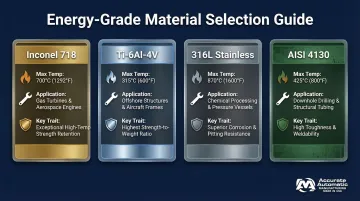
Inconel and titanium are particularly difficult to machine due to rapid work-hardening and high shear strength, requiring specialized tooling and rigid CNC setups. Steel alloys present a different challenge: in sour gas (H2S) environments, they must be heat-treated to keep hardness below 22 HRC, preventing sulfide stress cracking per NACE MR0175 requirements.
Understanding Machining Tolerances
Tolerance specifications have direct economic and performance implications:
- Standard commercial tolerances: ±0.005" (0.13 mm) — adequate for non-critical features
- Precision tolerances: ±0.001" or tighter — required for bearing seats, sealing surfaces, and pressure boundaries
Moving from standard to precision tolerances significantly increases machining time, fixturing rigidity requirements, and inspection costs. Engineers apply ASME Y14.5 Geometric Dimensioning and Tolerancing (GD&T) strategically, reserving ultra-tight tolerances for critical mating, bearing, and sealing surfaces — not every feature on the part.
Surface Finish and Secondary Treatments
Surface finish directly affects sealing performance and corrosion resistance. API 6A mandates Ra 0.8 µm finishes for metal-to-metal sealing surfaces. Surface roughness determines the number of circumferential leakage channels on a mating face, which directly controls leakage rate in high-pressure fluid systems.
Post-machining treatments extend component life:
- Passivation (ASTM A967): Chemical treatment for stainless steel to remove free iron and enhance corrosion resistance
- Heat treatment: Controlled tempering of alloy steels to maintain hardness below 22 HRC for sour service
- Specialized coatings: Tungsten carbide or molybdenum disulfide on valve trims and bearing rollers to reduce friction and prevent galling
Choosing the Right CNC Precision Machining Partner for Energy Projects
Core Evaluation Criteria
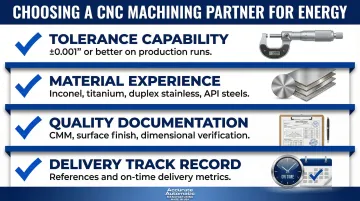
When evaluating a machining partner for energy components, prioritize these capabilities:
- Documented tolerance capability: Look for shops that can prove achieving ±0.001" tolerances or better on production runs, not just prototype parts.
- Material experience: Verify hands-on experience with energy-sector alloys — Inconel, titanium, duplex stainless, and API-grade carbon steels. Cutting superalloys requires specialized tooling and process knowledge.
- Quality documentation: Request evidence of inspection protocols and measurement capabilities, including CMM, surface finish testing, and dimensional verification.
- On-time delivery track record: Late delivery of critical components can halt entire construction schedules. Ask for references and delivery performance metrics.
The Importance of Communication and Workmanship Culture
In high-stakes energy projects, a machining partner who invests in the relationship delivers more value than one treating orders as transactional. Look for shops that:
- Understand the application and operating environment
- Flag potential design or manufacturability issues before production begins
- Stand behind the quality of every part with documented inspection reports
- Communicate proactively about lead times, material availability, and potential challenges
Accurate Automatic MFG operates this way as standard practice. The shop offers engineering services alongside its CNC milling, turning, and screw machine capabilities — meaning it can engage on application details before a single part is cut, not just after a purchase order arrives.
Additional Partner Selection Factors
Beyond communication, three structural factors round out a strong partner evaluation:
- Prototype and production flexibility: Choose shops that handle both initial prototype runs and full production volumes, so you can validate designs before scaling.
- Material traceability: For nuclear and API-regulated applications, verify the shop can provide heat numbers, lot numbers, and material certifications with every shipment.
- Pre-quote engineering review: A shop willing to review drawings, suggest design improvements, and identify issues before quoting signals technical competence and genuine customer focus.
Frequently Asked Questions
What is CNC precision machining?
CNC precision machining is a computer-controlled subtractive manufacturing process where programmed software directs cutting tools to remove material from a workpiece, producing parts with dimensional tolerances of ±0.001" or better. Industries like energy rely on it when component accuracy directly affects performance, fit, and safety.
What is +/- 0.01 tolerance?
A ±0.01 tolerance means a finished dimension can vary no more than 0.01 units (inches or mm per the drawing) above or below the specified value. In energy applications, even small deviations can compromise sealing, fit, or structural integrity under extreme pressure and temperature.
Which energy sectors rely most on CNC precision machining?
Oil and gas, wind energy, solar, nuclear and conventional power generation, hydroelectric, and geothermal are the primary sectors. Each depends on CNC machining to produce components that withstand unique pressures, temperatures, and environmental conditions — from 20,000 psi downhole tools to 1,600°C turbine blades.
What materials are commonly used in CNC machined energy components?
Stainless steel (316L), titanium (Ti-6Al-4V), Inconel (718/625), alloy steel (4130/4140), and engineering plastics are common. Material selection is driven by the operating environment — corrosion resistance for offshore, high-temperature strength for turbines, pressure containment for downhole tools, and mechanical load capacity for structural components.
How does CNC machining support renewable energy manufacturing?
CNC machining produces the components renewable energy systems depend on: turbine hubs and shafts for wind, mounting systems and slew drives for solar, and blades for hydroelectric. The precision and repeatability ensure long service life in demanding outdoor environments.