
Introduction
A single CNC machine can produce a surgical implant, a custom gear, and a decorative wall panel — making it one of the most flexible manufacturing technologies available today. That flexibility comes from CNC (Computer Numerical Control) machining's ability to run pre-programmed software that controls cutting, milling, turning, and drilling across metals, plastics, wood, and composites. The result: consistent precision at scale, across nearly any material.
Whether you're an engineer sourcing aerospace components or a product designer prototyping a consumer device, understanding what CNC machining can produce helps you make smarter manufacturing decisions. This article covers 32 distinct product types, grouped by industry, so you can see exactly where CNC machining fits your needs.
Key Takeaways
- CNC machines produce parts from metals, plastics, wood, and composites with tolerances as tight as ±0.001 inches
- Products span from heavy-duty industrial components to consumer goods like jewelry and custom enclosures
- Aerospace, automotive, medical, defense, electronics, and construction rely heavily on CNC-machined products
- Material expertise and quality control from the right machining partner directly determine final part outcomes
What Is CNC Machining and Why Does It Matter?
CNC machining is a computer-controlled process that directs cutting tools to remove material from a workpiece according to a pre-programmed design. Machines operate in 2, 3, or 5 axes depending on part complexity, with 5-axis systems allowing the cutting tool to approach the workpiece from almost any angle.
That range of motion matters because it lets CNC systems eliminate human error in repetitive cuts, maintain consistent tolerances across high-volume runs, and replicate complex geometries that manual machining cannot achieve reliably.
According to research on aerospace machining, 5-axis CNC milling achieves linear tolerances of ±0.002 mm to ±0.01 mm — precision required for critical components like turbine blades and landing gear.
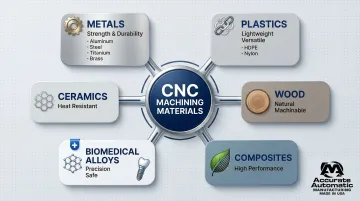
CNC machines work with aluminum, steel, titanium, brass, HDPE, nylon, wood, and composites. That material range drives the variety covered in this guide — from biomedical implants requiring ASTM F136 titanium to decorative signage cut from acrylic.
Industrial and Mechanical Products (Products 1–10)
Industrial and mechanical parts represent the most common CNC output — components that must meet tight dimensional tolerances and withstand operational stress in machinery, vehicles, and infrastructure.
Engine Components
CNC-machined engine parts include pistons, cylinder heads, crankshafts, and engine blocks. These must be machined from high-strength alloys with tolerances often measured in thousandths of an inch. GM engine specifications require cylinder bore out-of-round and taper tolerances held to a maximum of 0.0005 inches, making CNC the only viable production method at scale.
Cylinder bore surface finish directly controls lubrication oil consumption, blow-by, and exhaust emissions — which is why surface quality is specified alongside dimensional tolerances in engine build standards.
Custom Gears and Sprockets
CNC machining produces spur gears, helical gears, worm gears, and sprockets with precise tooth geometry for:
- Industrial equipment and conveyor systems
- Automotive transmissions
- Robotics drive systems
- Power transmission assemblies
Gear manufacturing follows strict standards like ANSI/AGMA 2015-1-A01 and ISO 1328-1, which establish tolerance classifications for flank deviations, pitch, and profile. CNC gear grinding eliminates hardening distortions to achieve the smooth, precise mesh required for high-load applications.
Hydraulic Components and Valves
CNC mills and lathes produce hydraulic manifolds, valve bodies, and fittings where internal channel accuracy directly affects fluid control performance. ISO 4401 CETOP standards require mounting surface roughness of Ra ≤ 0.8 µm and flatness of 0.01 mm per 100 mm.
Missing these tolerances causes high-pressure fluid leaks, pressure drops, and equipment failure — consequences that make CNC the required production method for manufacturing and oil/gas applications.
Molds, Dies, and Tooling Fixtures
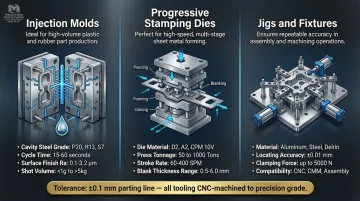
Injection molds, stamping dies, and jigs are themselves CNC-machined — and must hold exact cavity dimensions to produce high-volume plastic, rubber, and metal parts consistently. Common tooling types include:
- Injection molds for plastic and rubber components
- Progressive stamping dies for sheet metal parts
- Jigs and fixtures for downstream assembly and welding operations
CNC hard milling and Electrical Discharge Machining (EDM) cut hardened tool steels to strict ASME Y14.5 GD&T profile tolerances. A mismatch of even 0.1 mm at the parting line creates unacceptable flash or steps on final molded parts, leading to high reject rates.
Shafts, Brackets, and Structural Supports
CNC-turned shafts, rods, mounting brackets, and structural support components are workhorses of industrial assembly. These parts are produced in high volumes and customized to exact load-bearing and dimensional specs using materials like AISI 4140 alloy steel and AISI 1045 medium-carbon steel.
Each component is machined to ISO 286 fit system specifications, which define tolerance classes — such as H7/h6 — to guarantee the correct clearance, transition, or interference fit with mating bearings and couplings.
Medical, Aerospace, and Defense Products (Products 11–19)
These industries demand the tightest tolerances, strictest material certifications, and zero-defect quality — areas where CNC machining's repeatability and 5-axis capability are indispensable.
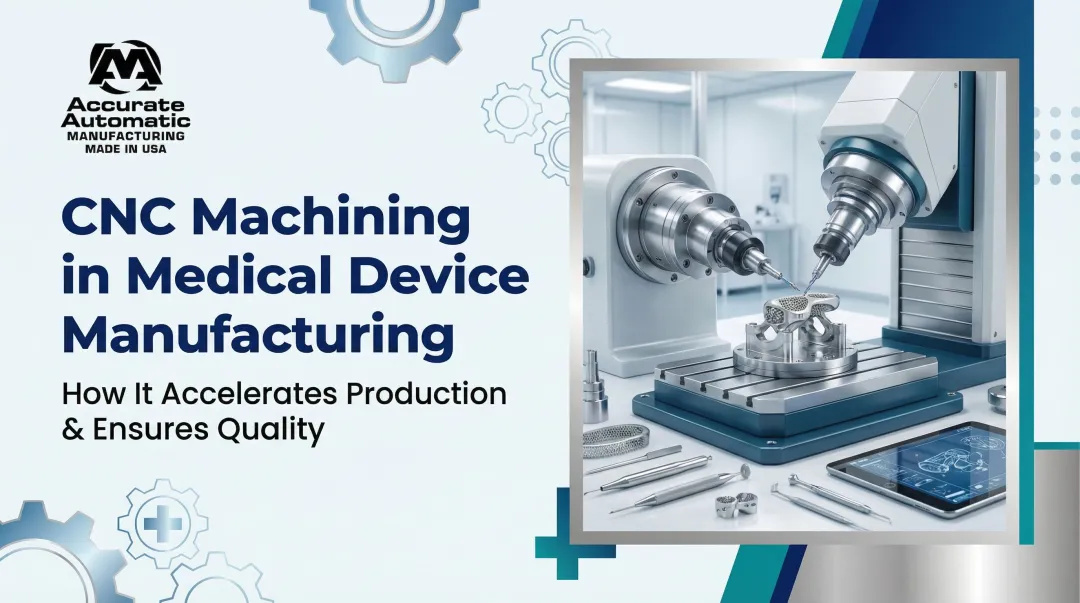
Orthopedic Implants and Surgical Instruments
Knee, hip, and spinal implants are CNC-machined from medical-grade alloys like Ti-6Al-4V ELI (ASTM F136) and 18Cr-14Ni-2.5Mo stainless steel. Surgical instruments including bone saws, scalpels, and precision clamps require biocompatible materials with specialized tooling and surface finishing.
To ensure optimal bone integration and reduce bacterial adhesion, CNC machining must achieve surface roughness below Ra 0.2 µm. Hip and knee implants require tolerances as tight as ±2 microns for perfect anatomical fit — precision that directly affects patient outcomes.
Dental Implants and Components
Dental posts, abutments, and prosthetic frameworks are CNC-milled from titanium or Y-TZP Zirconia (ISO 13356). Marginal fits must be below 20 microns to prevent bacterial infiltration, though aggressive machining can induce surface flaws ranging from 2 to 15 µm if feed rates and cutting depths aren't strictly controlled.
Aerospace Structural Parts and Turbine Blades
A slight deviation in turbine blade geometry can increase fuel consumption by 1-2% per flight. Aerospace components demand tolerances that leave almost no room for error:
- Turbine blades (Inconel 718): 5-axis milling to ±0.02 mm tolerance and Ra ≤ 0.2 µm surface finish for aerodynamic efficiency at 20,000–30,000 RPM
- Landing gear components (300M or 4340 steel): deep-hole drilling at depth-to-diameter ratios exceeding 20:1
- Wing spars and ribs (7075-T6 aluminum): ±5 µm linear tolerance to prevent distortion under 3–5g aerodynamic loads
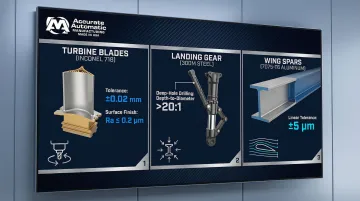
Traditional 3-axis machining can't efficiently handle these compound curves without multiple setups that introduce error. For aerospace work, 5-axis capability isn't optional.
Firearm Components and Military Equipment
CNC machining has largely replaced hand-crafting for firearm receivers, barrels, and trigger assemblies. CNC lathes handle external profiling and chambering, while multi-axis mills machine complex receiver geometries. CNC honing systems improve bore roundness and diameter uniformity prior to rifling.
Military hardware — weapon mounts, communication device housings, and ballistic shield frames — demands hard materials and precise repeatability that manual machining can't reliably deliver. Defense contractors depend on AS9100D and NADCAP-certified facilities to ensure 100% traceability and full MIL-SPEC compliance.
Accurate Automatic MFG's CNC milling and turning services support this level of precision work, producing tight-tolerance components where dimensional accuracy is a safety requirement, not just a quality metric.
Consumer, Commercial, and Electronics Products (Products 20–27)
From smartphone housings to architectural woodwork, CNC machining supplies components across consumer, commercial, and electronics markets — often where tight tolerances and cosmetic finish quality are equally non-negotiable.
Electronic Enclosures and Heat Sinks
CNC-machined aluminum enclosures protect sensitive circuit boards and processors in devices from smartphones to industrial sensors. Heat sinks rely on precise fin geometry to maximize thermal dissipation.
A non-flat base creates air gaps that increase thermal resistance by 30–50%, making contact surface flatness critical. CNC machining holds flatness to ≤ ±0.05 mm, but fin aspect ratios (height to width) should not exceed 6:1 for aluminum or 4:1 for copper to avoid tool deflection and cost inflation.
Prototypes and Product Development Parts
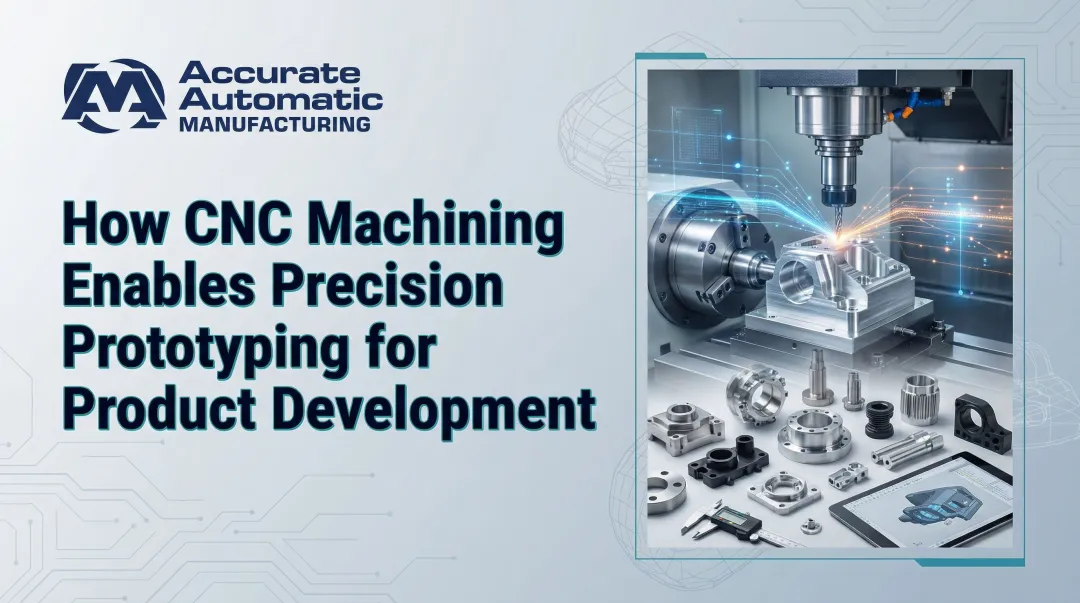
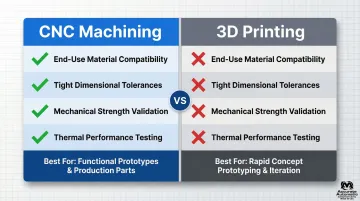
CNC machining is the preferred method for functional prototypes before committing to production tooling. Engineers in automotive, consumer electronics, and medical fields test form, fit, and function on real material with real tolerances — catching design flaws before expensive tooling is cut.
Unlike 3D printing, CNC allows testing in actual end-use materials — 7075-T6 aluminum, 1018 steel, PEEK — validating mechanical strength and thermal performance under real operating conditions.
Custom Automotive Parts
CNC produces aftermarket and OEM automotive components including:
- Custom forged wheels carved from solid 6061-T6 aluminum blanks
- Rigid monobloc brake calipers
- Suspension control arms
- Dashboard trim and interior components
The automotive sector demands parts that are both dimensionally accurate and cosmetically finished, with tight tolerances for bearing surfaces and mounting interfaces.
Custom Furniture and Architectural Millwork
Industrial CNC routers process hardwoods, MDF, and laminates for furniture and architectural millwork:
- Table bases and custom furniture components
- Cabinet doors and drawer fronts
- Decorative panels and moldings
- Door frames and shelving
The Architectural Woodwork Institute (AWI) establishes strict tolerances — for example, flatness and warp tolerances of cabinet doors must not exceed 6.4 mm (0.250 inches).
Signage and Branding Elements
CNC machines produce dimensional signage, custom nameplates, and branded display components from metal, acrylic, or wood. Businesses use these for interior and exterior branding where consistent letter geometry and finish quality matter.
CNC routers precisely cut and profile materials like High-Density Urethane (HDU), acrylics, PVC, and aluminum composite materials, delivering the edge consistency and repeatability that commercial signage demands at scale.
Specialty, Creative, and Emerging Application Products (Products 28–32)
From wind turbine hubs to hand-engraved jewelry, the final five product categories show how broadly CNC machining applies across industries.
Renewable Energy Components
CNC machining supports renewable energy by producing massive structural components for wind turbines, including hubs and precision molds used to lay up fiberglass and carbon-fiber blades. Aerodynamic tolerances on these blades directly impact the turbine's coefficient of performance and annual energy yield.
In solar energy, CNC machines drill, tap, and mill aluminum extrusions for solar panel mounting frames — with precise hole positioning critical for rapid field assembly.
Marine and Agricultural Equipment Parts
Marine propellers, shafts, and fluid-handling components operate in highly corrosive environments. Shops machine them from materials like 316 stainless steel, nickel aluminum bronze, and Duplex 2205 stainless steel.
Duplex 2205 deserves special mention: it resists chloride stress-corrosion cracking well, but its yield strength is twice that of standard austenitic grades. That means highly rigid CNC setups and carefully optimized cutting parameters are necessary to control rapid work hardening.
Agricultural parts — tractor components, irrigation fittings, harvesting equipment pieces — benefit from the same material discipline. Dimensional consistency across replacement parts directly reduces equipment downtime.
Jewelry, Games, and Decorative Art
Desktop and small-format CNC mills bring industrial precision to creative applications:
- Precision-engraved jewelry (rings, pendants, custom pieces)
- Game boards (chess sets, cribbage, backgammon)
- Puzzles and decorative wall art
- Custom awards and trophies
These machines cut waxes, precious metals, brass, and engineering plastics with mechanical resolutions as fine as 0.0004 inches (0.01 mm) and spindle speeds up to 15,000 RPM — ideal for micro-tooling and intricate engraving.
How to Choose the Right CNC Machining Partner for Your Product
The machine is only part of the equation. The expertise of the machining partner, their material knowledge, quality control processes, and ability to hold tolerances to spec across a production run matter just as much.
Key factors to evaluate:
Material compatibility: Does the shop have experience with your required material — titanium, hardened steel, or engineering plastics? Metals generally hold ISO 2768 "fine" (f) tolerances reliably; plastics are typically held to "medium" (m) due to thermal expansion.
Tolerance capability: Can they consistently hold the tolerances your part requires? Over-tolerancing — specifying tighter tolerances than functionally necessary — sharply increases costs through slower feeds, frequent tool changes, and higher scrap rates.
Quality systems: Do they have documented inspection processes and traceability? For medical, aerospace, or hydraulic applications, this is mandatory for compliance — not optional.
Turnaround and delivery reliability: Can they meet your production schedule without sacrificing workmanship? Reliable delivery timing affects your entire project timeline, whether you need prototypes or repeat runs.
Communication and service: Do they flag design-for-manufacturability issues before cutting starts? The best partners catch problems early and suggest modifications that improve manufacturability without compromising function.
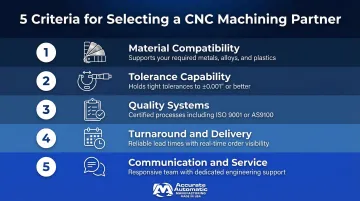
A shop that checks all five boxes — like Accurate Automatic MFG, which offers CNC milling, CNC turning, screw machine operations, and engineering services — can handle everything from one-off prototypes to repeat production runs without dropping the ball on quality or delivery.
Frequently Asked Questions
What products can be made on a CNC machine?
CNC machines produce an enormous range of products — from industrial parts like engine components, hydraulic valves, and precision gears to consumer items like custom furniture, dimensional signage, jewelry, and electronic enclosures. The common thread is precision and repeatability across diverse materials including metals, plastics, wood, and composites.
What are the 5 common types of CNC machines?
The five most common types are:
- CNC mills — rotating multi-point cutting tools operating on stationary workpieces
- CNC lathes — rotating workpieces cut against a stationary tool
- CNC routers — gantry-style machines designed for large sheet materials
- CNC EDM machines — electrical discharge machining for hardened or difficult materials
- Mill-turn centers — combine lathe and mill capabilities in a single setup
What materials can CNC machines work with?
CNC machines work with aluminum, steel, titanium, brass, copper, HDPE, nylon, ABS, wood, MDF, and composites. Material choice depends on the product's strength, weight, and environmental requirements. For example, medical implants require biocompatible titanium, while marine components need corrosion-resistant materials like Duplex 2205 stainless steel.
Can CNC machines produce both one-off custom parts and high-volume production runs?
Yes. CNC machining handles both scenarios well. Prototypes and custom one-offs benefit from quick setup and design flexibility without expensive tooling investment. High-volume runs rely on programmed repeatability to maintain consistent tolerances across thousands of identical parts.
How precise are CNC-machined products?
CNC machining routinely achieves tolerances of ±0.001 inches (±0.025 mm) or tighter depending on machine type, setup, and material. Precision applications like medical implants, aerospace components, and hydraulic manifolds can achieve tolerances as tight as ±2 microns, making CNC the manufacturing method of choice where dimensional accuracy is safety-critical.
What industries benefit most from CNC machined products?
Aerospace, automotive, medical, defense, electronics, oil and gas, renewable energy, marine, and construction all depend on CNC machining. Any industry that requires precision parts at consistent quality — which describes most of modern manufacturing — relies on CNC processes in some capacity.