Introduction
Industries like aerospace, automotive, and medical devices are pushing manufacturing harder than ever in 2026 — demanding faster lead times, tighter tolerances, and lower per-part costs.
Custom parts manufacturing has evolved well beyond single-process shops. Today's operations handle complexity, volume variability, and tight delivery windows at the same time.
The numbers back this up. The global precision machining market hit $117.2 billion in 2024 and is projected to reach $243.8 billion by 2034, growing at a 7.6% CAGR. The on-demand custom parts segment is moving even faster — from $4.60 billion in 2024 to a projected $11.66 billion by 2032.
That growth signals a clear expectation: manufacturers need partners who can deliver production-ready parts with short lead times and micron-level accuracy, not one or the other.
Key Takeaways
- Custom parts manufacturing spans five key solutions: CNC precision machining, additive manufacturing, rapid injection molding, sheet metal fabrication, and hybrid systems
- CNC machining leads in dimensional accuracy (±0.001"), while additive manufacturing excels in complex geometries and rapid iteration
- Hybrid manufacturing combines additive and subtractive processes to achieve complex shapes with tight tolerances in fewer production steps
- AI-driven quality control and digital workflows cut inspection time and reduce defect rates across modern production floors
- Choose a shop with multiple in-house capabilities — fewer handoffs means faster delivery and tighter quality control throughout
Overview of Custom Parts Manufacturing Solutions in 2026
Custom parts manufacturing refers to the production of components built to specific design files, tolerances, and material requirements—for low-to-mid volumes where off-the-shelf parts won't suffice. Unlike mass production, custom manufacturing prioritizes flexibility, precision, and rapid turnaround for specialized applications.
The U.S. manufacturing landscape is undergoing a reshoring surge. In 2024 alone, 244,000 manufacturing jobs were announced through reshoring and foreign direct investment, driven by supply chain localization and tariff pressures.
That momentum has tightened domestic contract manufacturing capacity. Buyers who wait to identify partners often face extended lead times—making early supplier qualification a competitive advantage, not just a procurement checkbox.
The sections below outline the leading manufacturing approaches serving industrial buyers today—from prototype machining to high-volume screw machine work. Matching the right process to your part geometry, material, and volume is where cost and lead time are really won or lost.
Best Manufacturing Solutions for Custom Parts Production in 2026
These solutions were selected based on precision capability, material versatility, production scalability, and relevance to 2026 manufacturing demands.
CNC Precision Machining
CNC machining remains the gold standard for tight-tolerance, production-ready custom parts. Using subtractive processes across metals, plastics, and composites, modern CNC operations achieve micron-level accuracy that other manufacturing methods struggle to match.
Key differentiators include:
- 5-axis machining eliminates multiple setups and reduces cycle times by up to 30%
- Automated toolpath generation minimizes programming time and human error
- Rapid prototype turnaround in as little as 24-72 hours from short setup times
- Covers both functional testing and final production runs without process changes
The CNC operation segment dominates the precision machining market, accounting for 78.9% of the share in 2025. Advanced 5-axis CNC machining centers are projected to grow by $875.4 million through 2029, driven by demand for complex aerospace and medical components.
Accurate Automatic MFG represents this category well as a multifaceted precision manufacturing company. They offer CNC milling for complex part manufacturing, CNC turning for cylindrical components, and screw machine operations for high-speed production of small to medium parts—all backed by engineering services that provide technical design support.
| Feature | Details |
|---|---|
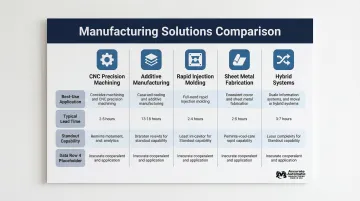
| Best For | High-precision parts, tolerance-critical components, metal and engineering plastic materials |
| Typical Lead Time | 24-72 hours for prototypes; production runs vary by volume and complexity |
| Key Strengths | Dimensional accuracy (±0.001" to ±0.005"), extensive material range, production-ready finish quality |
Additive Manufacturing (3D Printing)
Additive manufacturing has evolved from a prototyping tool to a production-capable solution covering FDM, SLA, SLS, and DMLS processes across polymers, composites, and metals. The global AM market reached $24.2 billion in 2025, with printing services growing 15.5% year-over-year.
Key differentiators include:
- Design freedom to produce complex internal geometries that machining cannot reach
- Zero tooling costs, making low-volume runs economically viable from the first part
- Same-day design changes through rapid iteration cycles
- Multi-material capabilities with AI-driven print optimization
Industrial adoption has moved into production applications at scale. GE Aviation has shipped over 100,000 3D-printed fuel nozzle tips, consolidating 20 welded pieces into one integrated component while cutting weight by 25%. Airbus manufactures 25,000 flight-ready polymer parts annually using FDM, achieving 43% weight reduction and 85% faster lead times for A350 components.
AI-driven in-situ monitoring is reducing defect rates by 30-50% in production environments—making AM increasingly viable for mission-critical aerospace and medical applications.
| Feature | Details |
|---|---|
| Best For | Complex geometries, low-volume runs, functional prototypes, lightweight aerospace/medical components |
| Typical Lead Time | Same-day to 5 days depending on process and material |
| Key Strengths | Geometric freedom, low setup cost, iterative speed, material efficiency for expensive alloys |
Rapid Injection Molding
Rapid injection molding connects prototype validation to production output, using aluminum tooling and digital mold-flow analysis to deliver hundreds to thousands of production-grade parts quickly. The market is expanding rapidly as manufacturers seek faster time-to-market without committing to expensive steel tooling.
Key differentiators include:
- Production-realistic materials with identical properties to final parts
- Aluminum tooling cuts lead times from 8+ weeks to days or weeks
- Hybrid workflows incorporating 3D-printed mold inserts with conformal cooling channels
- In-mold sensor validation for process accuracy
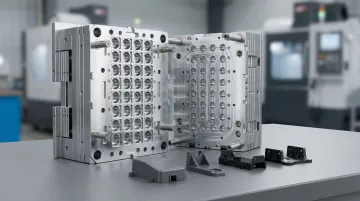
Aluminum molds can be machined up to twice as fast as steel and don't require post-machining heat treatment. While tool life is shorter (2,000-10,000 shots vs. 1,000,000+ for hardened steel), this makes rapid injection molding ideal for bridge production, market validation, and low-to-mid volume manufacturing.
3D-printed mold inserts with conformal cooling channels have been shown to reduce production cycle times by up to 17%, delivering faster throughput without sacrificing part quality.
| Feature | Details |
|---|---|
| Best For | Mid-volume runs of plastic parts requiring production-grade material properties |
| Typical Lead Time | 7-15 days for tooling plus parts |
| Key Strengths | Production-accurate materials, scalable from hundreds to thousands of parts, design flexibility |
Sheet Metal Fabrication
Sheet metal fabrication handles structural custom part production through laser cutting, automated bending, and forming—covering enclosures, brackets, panels, and frames across robotics, automotive, and electronics applications.
Key differentiators include:
- CAD-to-cut digital integration that automates file cleanup and nesting during quoting
- Fast structural turnaround with 1-3 day lead times for standard geometries
- Fiber laser technology enabling precision cuts with minimal heat-affected zones
- Bridge from concept to production tooling for rapid design validation
The global sheet metal fabrication services market is projected to grow from $18.50 billion in 2025 to $29.85 billion by 2034. However, 85% of fabricators report severe bottlenecks in press brake and bending operations, despite laser cutting lead times dropping to 1-3 days.
When sourcing sheet metal fabrication, audit potential suppliers for automated CAD-to-cut software and robotic bending cells to ensure your projects won't stall after the cutting phase.
| Feature | Details |
|---|---|
| Best For | Structural housings, enclosures, brackets, and panels requiring durability and repeatability |
| Typical Lead Time | 1-5 business days for standard geometries |
| Key Strengths | Structural integrity, rapid turnaround, CAD-integrated workflow, cost-effective for larger parts |
Hybrid Manufacturing Systems
Hybrid manufacturing represents the convergence of additive deposition and CNC milling in a single system—building complex near-net-shape geometries through directed energy deposition (DED) or powder bed fusion, then immediately finishing them to tight tolerances with integrated CNC machining.
Key differentiators include:
- Reduced material waste through near-net-shape printing followed by precision finishing
- Micron-level surface finishing post-print (improving Ra from 12 µm to <0.6 µm)
- 10x faster and 5x cheaper than standalone powder bed fusion for mid-size metal parts
- Suitability for high-value components in aerospace and energy sectors
The hybrid additive manufacturing machines market is projected to grow from $3.1 billion in 2025 to $25.5 billion by 2035 at a CAGR of 23.5%. This technology is especially well-suited for repairing damaged aerospace engine components and manufacturing complex parts like turbine blisks and manifolds.
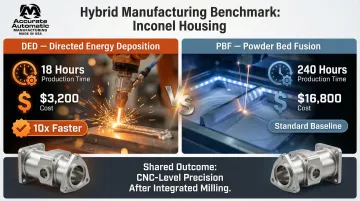
A benchmark study comparing DED to powder bed fusion found that DED was 10 times faster (18 hours vs. 240 hours) and 5 times less expensive ($3,200 vs. $16,800) for mid-size Inconel housings—while still delivering CNC-level precision after integrated milling.
| Feature | Details |
|---|---|
| Best For | High-value components needing geometric complexity plus tight surface tolerances |
| Typical Lead Time | Varies; best suited for advanced single-part or small-batch production |
| Key Strengths | Material efficiency, post-print precision finishing, design iteration flexibility, repair capabilities |
How to Choose the Right Manufacturing Solution for Custom Parts
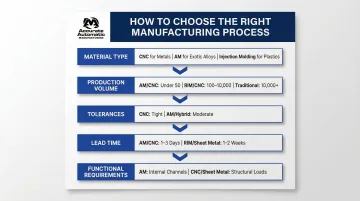
The most common mistake buyers make is selecting a manufacturing process based on availability or familiarity rather than part requirements—leading to tolerance failures, material mismatches, or unnecessary cost overruns.
Five criteria should drive the decision:
Material Type and Machinability
- Metals like aluminum and steel favor CNC machining for tight tolerances
- Exotic alloys (titanium, Inconel) benefit from AM's material efficiency
- Production plastics require injection molding for consistent properties
Production Volume
- Prototypes and low volumes (<50 units): AM or CNC machining
- Bridge production (100–10,000 parts): rapid injection molding or CNC
- High volume (>10,000 parts): traditional injection molding or CNC with economies of scale
- Small-batch specialty runs: screw machine operations often offer the best cost-per-part
Required Tolerances and Surface Finish
Tolerance requirements narrow your process options faster than almost any other factor.
- Tight tolerances (±0.001" to ±0.005"): CNC machining excels
- Moderate tolerances (±0.01mm): AM or hybrid systems work well
- Mating surfaces: always require post-machining
Lead Time Constraints
- Same-day to 3 days: AM for complex geometries, CNC for simple parts
- 1–2 weeks: rapid injection molding or sheet metal fabrication
- 3+ weeks: traditional tooling or complex CNC production runs
Functional Requirements
The part's end-use determines which processes are even viable.
- Complex internal channels: AM is often the only practical option
- High structural loads: CNC machining or sheet metal fabrication
- Production-identical validation: rapid injection molding
These criteria rarely point to a single obvious answer — trade-offs between cost, speed, and precision are the norm. That's why engaging your manufacturing partner during the design phase matters. Research consistently shows that the majority of a product's cost is determined before the first chip is cut. A shop with CNC milling, turning, and screw machine capabilities under one roof reduces supplier handoffs and keeps quality standards consistent when design changes come through.
Conclusion
In 2026, the best manufacturing solution for custom parts isn't a single technology—it's the right combination of process expertise, materials knowledge, and a partner who treats quality and delivery as non-negotiable. The businesses that succeed are those who choose partners capable across the full range of their machining needs—not just the straightforward runs, but the tight-tolerance, high-mix work that separates capable shops from exceptional ones.
When evaluating potential partners, look beyond their equipment list. Assess their workmanship culture, communication standards, and demonstrated ability to scale with evolving project demands. A strong partner brings your designs to life while also flagging opportunities to improve manufacturability, reduce cost, and strengthen part performance before production begins.
Accurate Automatic MFG specializes in CNC milling, CNC turning, and screw machine work for industrial clients who need precision, reliability, and responsive service. To discuss your next project, contact the team directly:
- Email: sales@accurateautomaticmfg.com
- Phone: +1 330-435-4575
Frequently Asked Questions
What are the manufacturing industry trends in 2025 and 2026?
Key trends include AI integration in production workflows (with 98% of manufacturers exploring AI-driven automation), accelerated reshoring of custom manufacturing to domestic facilities, increased adoption of hybrid and additive manufacturing for production applications, and growing demand for faster lead times with tighter quality standards. AI-driven quality control is reducing defect rates by 30-50% in production environments.
Which industry would benefit the most from AM's ability for rapid production of customized parts?
Aerospace and medical device manufacturing benefit most from additive manufacturing's ability to produce complex, patient- or application-specific parts quickly with minimal material waste. The medical sector has fully embraced AM for serial production of custom implants and prosthetics, while aerospace uses it for lightweight structural components and complex engine parts.
What is the difference between CNC machining and additive manufacturing for custom parts?
CNC machining is subtractive (removes material from solid stock) and excels at tight tolerances (±0.001" to ±0.005") and production-ready surface finishes. Additive manufacturing builds material layer-by-layer and is best for complex internal geometries and rapid iteration without tooling costs. CNC suits high-precision, production-volume parts; AM suits low-volume runs with geometric complexity.
How do I choose the right manufacturing process for low-volume custom parts?
Evaluate your material requirements, tolerance specifications, and whether parts need production-grade properties. CNC machining is often preferred for metal low-volume runs requiring tight tolerances, while SLS or DMLS 3D printing suits complex geometries in smaller quantities (under 50 units).
What tolerances can precision machine shops typically hold for custom parts?
Precision CNC machine shops commonly hold tolerances of ±0.001" to ±0.005" (approximately 25-125 microns) depending on material, part geometry, and machining operations. Advanced 5-axis CNC centers can achieve positional accuracy of 4-5 microns with surface roughness below 0.8 µm Ra. Always confirm tolerance capabilities with your shop based on your specific drawing requirements and material selection.
How long does it typically take to produce custom machined parts?
Lead times vary by process and complexity. CNC prototypes can be turned around in 24-72 hours for simple geometries, while production runs with tight tolerances or complex setups typically take 1-3 weeks. Confirm timeline expectations with your manufacturing partner upfront.