Introduction
Managing multiple vendors for a single production run creates a cascade of problems: missed handoffs between suppliers, conflicting schedules, inconsistent quality standards, and endless email chains trying to coordinate delivery dates. When your CNC shop delivers machined parts on time but your finishing vendor is three weeks behind, your entire product launch stalls—and there's no single point of accountability.
Turnkey manufacturing solves this fragmentation by consolidating the entire production lifecycle under one partner. Instead of juggling five purchase orders, you issue one PO to a single manufacturer who handles design support, materials sourcing, fabrication, assembly, and delivery.
That consolidation has a direct financial impact. According to CAPS Research, the average fully-loaded cost to process a single purchase order is $411 in manufacturing. A typical five-supplier project burns over $2,000 in administrative overhead before a single part is cut.
What follows covers the full picture: what turnkey manufacturing includes, how it stacks up against fragmented sourcing, which industries use it most, and what to look for in a partner.
Key Takeaways
- Turnkey manufacturing consolidates the full production process—design, sourcing, fabrication, assembly, and delivery—under one accountable partner
- Eliminates coordination waste: processing a single PO instead of multiple vendor orders cuts administrative costs by over $1,600 per project
- Reduces lead times by 20-50% by removing inter-vendor handoffs and enabling parallel production stages
- Best suited for complex, multi-process components where fragmented supplier management creates overhead that outweighs any cost savings
- Partner selection depends on in-house capabilities, quality certifications, and communication transparency
What Is Turnkey Manufacturing?
Turnkey manufacturing is a production model where a single manufacturing partner manages the entire lifecycle—from initial design and prototyping through fabrication, assembly, quality inspection, and final delivery. The customer provides specifications or a concept; the turnkey manufacturer delivers a finished, market-ready component or assembly.
The term "turnkey" originates from real estate and construction, where a buyer receives a property ready to occupy—just "turn the key" and move in. In manufacturing, it means handing over a requirement and receiving a completed product without managing the production details yourself.
Single-Point Accountability:
A turnkey partner acts as both project manager and executor. They coordinate all production stages—vendor selection, materials procurement, machining, finishing, assembly, and quality checks—either under one roof or through a tightly managed supply network. This single-point accountability eliminates the finger-pointing that occurs when multiple vendors blame each other for tolerance stack-ups or delivery delays.
True In-House vs. Managed Turnkey:
Not all turnkey providers are the same:
- In-house providers run all critical processes—CNC machining, welding, finishing, assembly—under one roof, which means tighter quality control and faster turnaround
- Managed providers coordinate specialized sub-suppliers, expanding capability but introducing additional handoffs and potential quality variability
The trade-off: in-house providers offer speed and control; managed providers offer access to specialized capabilities they don't own directly.
A useful parallel: instead of sourcing ingredients from five different grocery stores and managing your own cooking schedule, you place one order and receive a finished meal at your door. Turnkey manufacturing works the same way—you specify what you need, and the manufacturer handles sourcing, production, and delivery from start to finish.
What's Included in a Turnkey Manufacturing Solution?
Turnkey manufacturing encompasses multiple interconnected stages, each designed to close coordination gaps so clients spend less time managing vendors and more time on their core work.
Standard Stages Covered
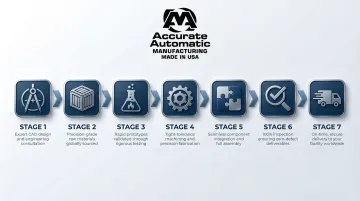
- Design and Engineering Support — Early-stage CAD review, tolerance analysis, and material recommendations to refine parts for manufacturability before production begins.
- Materials Sourcing and Procurement — The turnkey partner issues purchase orders, negotiates with suppliers, and consolidates all materials under one roof.
- Prototyping and Testing — Initial production runs to validate design intent, test fit and function, and surface manufacturing issues before full-scale production.
- CNC Machining and Fabrication — Precision cutting, milling, turning, and forming operations, often performed sequentially within the same facility.
- Sub-Assembly and Final Assembly — Integration of machined components, fasteners, and purchased parts into finished assemblies, so you don't need to coordinate that step elsewhere.
- Quality Inspection — In-process and final inspection using CMMs, optical comparators, and other metrology equipment to confirm dimensional and functional requirements are met.
- Delivery and Logistics Coordination — Packaging, labeling, and shipping directly to your facility or end customer, often with consolidated freight to cut transportation costs.
Design for Manufacturability (DFM): The Critical Early-Stage Service
DFM review ensures parts are optimized for efficient, repeatable production before any material is cut. Because 70-80% of a product's cost is locked in during early design phases, early DFM intervention is critical.
Documented case studies show DFM delivers:
- Part count reductions of 42% to 85%
- Manufacturing cycle time cuts of up to 60%
- Average total cost savings of 50% across aerospace, electronics, and industrial equipment
Without DFM, late-stage design changes follow the "Rule of 10," where modifications cost 10 to 100 times more after production begins than they would during the design phase.
Procurement and Supply Chain Management
The turnkey partner consolidates materials procurement, issuing a single purchase order on your behalf and handling all vendor negotiations.
According to APQC benchmarking data, the median cost to process a single PO is $54.94—but the average fully-loaded cost across industries is $411, rising to $483 in aerospace and defense. Consolidating five vendor POs into one turnkey order saves over $1,600 in administrative overhead per project.
Quality Control Integration Throughout Production
Embedded quality checkpoints at each production stage catch errors early, which is especially critical for precision components in aerospace, medical, and defense applications. The "1-10-100 Rule" of quality costs dictates that a defect costing $1 to prevent will cost $10 to correct during assembly, and $100 or more to remediate if discovered by the customer in the field.
Scope Varies by Provider and Project
Not all clients need full end-to-end service. Some require only partial turnkey solutions—for example, machining through assembly but not materials sourcing. When evaluating providers, assess your specific gaps: Do you need design support? Do you have established material suppliers, or should the turnkey partner handle procurement? Understanding your internal capabilities helps define the right scope.
Key Benefits of Turnkey Manufacturing Solutions
Faster Time to Market
Consolidating all production steps under one partner eliminates handoff delays between vendors, reduces scheduling conflicts, and allows overlapping processes—resulting in measurably shorter lead times.
Why Fragmentation Slows Production:
Supply chain fragmentation inherently extends lead times. Actual manufacturing cycle time often represents a small portion of total lead time; queue time—waiting for capacity, material, or transit between operations—frequently dominates. Every handoff between specialized vendors is an opportunity for delay.
By consolidating cutting, forming, welding, and finishing under one roof, turnkey manufacturers eliminate shipping delays and re-handling costs, compressing lead times by 20% to 50%. For example, Boeing and Airline MRO Parts (AMP) reduced Material Request to PO processing time by 75% through supplier consolidation.
Communication Advantage:
With one point of contact, design changes and problem-solving happen in real time—often within hours rather than days. Engineering Change Orders (ECOs) are especially vulnerable to multi-vendor delays: research shows value-added processing time for an ECO can be as low as 8.5%, with the rest lost to waiting and administrative congestion. A 5-hour task can take weeks when routed across a fragmented supply chain.
Simplified Supply Chain and Reduced Risk
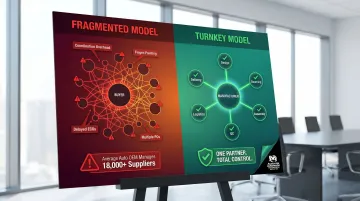
A single PO, one contract, and one accountable partner replace the complexity of coordinating five or more suppliers—reducing supplier risk, minimizing miscommunication, and giving buyers clearer oversight.
Risk Reduction Through Accountability:
If a problem arises, there is no finger-pointing between vendors. The turnkey partner owns the outcome, which aligns incentives and drives better quality accountability. When quality issues arise across multiple vendors, rework rarely costs less than double the original part price, and accountability ambiguity delays resolution.
The 18,000+ Supplier Burden:
According to McKinsey, the average auto manufacturer coordinates around 18,000 suppliers throughout their value chain, while aerospace and defense firms work with approximately 12,000 manufacturers. This fragmentation creates massive logistical and administrative relief opportunities for firms that consolidate relationships with a single turnkey supplier for given subassemblies.
Cost Predictability and Efficiency
While the upfront investment may appear higher with a turnkey partner, the total cost of ownership (TCO) is often lower when factoring in eliminated vendor management overhead, reduced rework from miscommunication, fewer quality failures, and faster time to revenue.
Shifting from Piece-Price to Total Cost of Ownership:
Fragmented sourcing may yield lower individual piece-prices, but it inflates TCO. APQC benchmarking reveals that top-performing organizations spend $26.31 per $1,000 in revenue on supply chain management, while bottom performers spend $107.09. That $80+ gap per $1,000 in revenue is driven almost entirely by vendor management complexity.
| Cost Driver | Fragmented / Multi-Vendor Model | Turnkey / Single-Source Model |
|---|---|---|
| Logistics & Freight | Multiplied LTL shipments, higher transit risk | Consolidated shipping, single freight charge |
| Admin Overhead | High (multiple POs, audits, invoices, supplier management FTEs) | Low (single PO, one point of contact, reduced FTE burden) |
| Inventory/WIP | High buffer stock required to manage timing mismatches | Lower WIP, synchronized JIT delivery |
| Quality Accountability | Ambiguous; vendors blame each other for tolerance stack-ups | Clear single-point accountability; unified QMS |
Rework Costs Attributable to Miscommunication:
Supplier miscommunication regarding design intent is a primary driver of unbudgeted costs and rework. McKinsey notes that late-stage design changes increase total development costs by 15–35% in regulated sectors.
Turnkey Manufacturing vs. Traditional Fragmented Manufacturing
| Dimension | Turnkey Manufacturing | Traditional Multi-Vendor |
|---|---|---|
| Number of Suppliers | One primary partner | 5-10+ specialized vendors |
| Communication Complexity | Single point of contact | Multiple contacts, coordination overhead |
| Lead Time | 20-50% faster due to eliminated handoffs | Longer due to queue time between vendors |
| Quality Accountability | Single partner owns outcome | Ambiguous; vendors blame each other |
| Administrative Burden | One PO, one contract, one invoice | Multiple POs ($411 each), multiple contracts |
When Traditional Fragmented Manufacturing Still Makes Sense
Turnkey is not a one-size-fits-all solution. Traditional multi-vendor manufacturing remains the better choice when:
- Parts require only a single manufacturing process — like basic sheet metal stamping — where price competition across multiple vendors undercuts bundled turnkey pricing.
- Your procurement team already manages a mature vendor network and prefers direct control over each supplier relationship.
- Supply chain resilience is a priority: 63% of public companies have increased dual/multi-sourcing to guard against geopolitical disruptions, natural disasters, and labor strikes.
For critical components, a "supplier + 1" or regional dual-sourcing approach often works best — capturing the efficiency of turnkey integration while building in regional redundancy.
The best choice depends on part complexity, production volume, internal capabilities, and speed-to-market pressure.
Industries That Benefit Most from Turnkey Manufacturing
Highly regulated industries rely heavily on turnkey and integrated Tier-1 suppliers to manage complex compliance requirements and mitigate risk.
Aerospace & Defense
AS9100 Clause 8.4.3 requires strict control and flow-down of requirements to external providers, including counterfeit parts prevention and right of access. Turnkey Tier-1 suppliers absorb the administrative burden of auditing sub-tier vendors and ensuring DFARS/ITAR compliance.
Automotive & EV
IATF 16949 mandates rigorous supplier risk assessments, PPAP (Production Part Approval Process), and APQP documentation. OEMs use integrated suppliers to manage these extensive validation requirements and ensure zero-defect launches.
Medical Devices
ISO 13485 emphasizes strict regulatory compliance, risk management, and traceability. Because medical device recalls can cost up to $600 million, OEMs partner with certified turnkey manufacturers to ensure consistent cleanroom assembly and mitigate demand volatility.
Defense, Industrial Equipment, and Electronics
These sectors share a common challenge: multi-component assemblies that span several distinct manufacturing processes — machining, forming, molding, and finishing — are simply impractical to coordinate across fragmented vendors at the pace and precision required.
Startups and OEMs Launching New Products
Beyond established industries, turnkey solutions are equally valuable at a specific business stage. Startups and growing OEMs often lack the internal manufacturing infrastructure, procurement bandwidth, and established supplier networks required to launch complex products. Turnkey manufacturing lets them bypass heavy capital expenditures — facilities, equipment, tooling — and access mature supply chains that accelerate commercialization.
How to Choose the Right Turnkey Manufacturing Partner
Selecting a turnkey partner is a long-term strategic commitment. Evaluate partners across the following criteria:
Key Evaluation Criteria
| Criteria | Key Considerations |
|---|---|
| Capabilities Alignment | Does the CM perform critical processes (machining, welding, assembly) in-house, or do they heavily subcontract? In-house capabilities ensure better quality control. |
| DFM & Engineering Support | Can the supplier provide early Design for Manufacturability feedback to optimize costs before production? |
| Financial Stability | Is the CM financially solvent enough to weather supply chain disruptions without going out of business? |
| Capacity & Scalability | Does the facility have the physical space and dedicated personnel to scale from prototyping to high-volume production? |
| Supply Chain Transparency | How does the CM manage their own Tier-2/Tier-3 suppliers? Do they collaborate on Quality Checklists? |
The Importance of In-House vs. Outsourced Capabilities
A partner who performs CNC machining, finishing, and assembly in-house offers tighter quality control and faster turnaround than one who sub-contracts most work. Ask for a clear breakdown of what is done in-house vs. outsourced — and push for specifics, not generalizations.
The Impact of Quality Certifications
Look for certifications such as ISO 9001, AS9100, IATF 16949, or ISO 13485, depending on your industry. Empirical studies demonstrate that implementing ISO 9001 quality management systems has a significant positive impact on operational performance, including increased product quality, higher productivity, and improved customer satisfaction. Furthermore, 74% of buyers feel ISO certification makes a company more credible, directly linking certified QMS environments to reduced defect rates and reliable delivery.
Accurate Automatic MFG: A Precision Manufacturing Partner Built Around the Turnkey Philosophy
Accurate Automatic MFG is a precision machine shop with in-house capabilities spanning CNC milling, CNC turning, screw machine operations, and engineering services. That range of in-house capacity — covering both the machining and engineering stages — lets them handle projects from initial DFM review through finished component delivery without relying on a network of subcontractors.
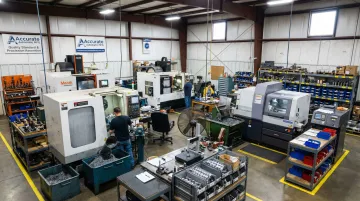
The company's focus on customer relationships and workmanship quality maps directly to what buyers should prioritize when vetting a turnkey partner: accountability at every stage, not just at final inspection.
For companies seeking a precision manufacturing partner who can consolidate multiple processes under one roof while maintaining tight quality control, reach out to Accurate Automatic MFG to discuss your specific requirements.
Frequently Asked Questions
What is the difference between turnkey manufacturing and contract manufacturing?
Contract manufacturing typically means a vendor produces parts to your spec using your supply chain coordination. Turnkey manufacturing means the partner manages the entire process—from sourcing to final assembly—as a single point of accountability, eliminating your coordination burden.
Which industries use turnkey manufacturing solutions most frequently?
Aerospace, medical devices, automotive, defense, and industrial equipment—industries that require complex, multi-process components with tight tolerances, high reliability standards, and stringent regulatory compliance.
How does turnkey manufacturing reduce lead times?
By eliminating vendor handoffs and enabling parallel processing of production stages, turnkey solutions remove the scheduling gaps and communication delays that slow down multi-supplier production runs, reducing lead times by 20-50%.
Are there any drawbacks to turnkey manufacturing?
Turnkey may offer less price competition for individual components compared to sourcing each process separately, and the client has less direct control over each sub-process. Single-sourcing also introduces dependency risk, making partner selection and potential dual-sourcing strategies worth considering from the start.
Is turnkey manufacturing suitable for low-volume or prototype production?
Yes, turnkey is especially valuable for new product introductions and low-volume precision runs where managing multiple vendors for small batches would be disproportionately complex and costly, allowing startups and OEMs to accelerate commercialization.
What questions should I ask a potential turnkey manufacturing partner?
Key questions to ask include:
- Which processes are handled in-house vs. outsourced?
- What quality certifications do you hold?
- Can you share examples of similar multi-process projects?
- How do you handle project communication and reporting?
- What is your typical lead time for multi-process components?